This post contains affiliate links. If you book or buy through them, I earn a commission at no extra cost to you. As an Amazon Associate I earn from qualifying purchases.
In this post Day 8 of our two-week Portugal road trip: an Óbidos and Nazaré day trip by car. We walked flower-scented lanes and one railing-free stretch of the town wall in Óbidos, then spent a long while on the cliff trail above Nazaré’s north beach watching rough waves, and ended the day in Coimbra.
- WhenSunday, March 24, 2024, day 8 of our trip
- Route
- Leave Vendas Novas
- Óbidos: town gate and lanes, one stretch of the wall walk, a net hammock with a view, coffeeA little over an hour in town
- Arrive in Nazaré, late lunchAbout 2 hr 45 min in Nazaré in all
- Waves from the cliff trail at Praia do Norte (North Beach)About an hour of that
- Arrive in Coimbra, dinner at a buffet on the edge of town
- AdmissionPaid · Nazaré lighthouse fort (Forte de São Miguel Arcanjo) €3 (checked October 2026); we didn’t go inFree · Óbidos lanes and wall walk (we paid no admission), Nazaré cliff trail and viewpoints
- BookingWe booked each night’s stay as we went, which the off-season made easyNo reservations for Óbidos or Nazaré
- WeatherSlightly overcast but not cold. Óbidos smelled of flowers and felt like spring; in Nazaré, the wind off the sea was strong.
- WhoThe three of us: my wife, our kid and me
- Where we sleptNH Coimbra Dona Inês, Coimbra, one night
North from Vendas Novas
We had breakfast at the B&B in Vendas Novas where we’d spent the night, then got into the rental car. Before leaving town we stopped at the local Lidl for snacks.
The plan for the day was to drive up the west coast, stop in Óbidos and Nazaré, and reach Coimbra by evening. The whole route came to about 285 km (177 mi) on Google Maps, a little over three and a half hours of driving.
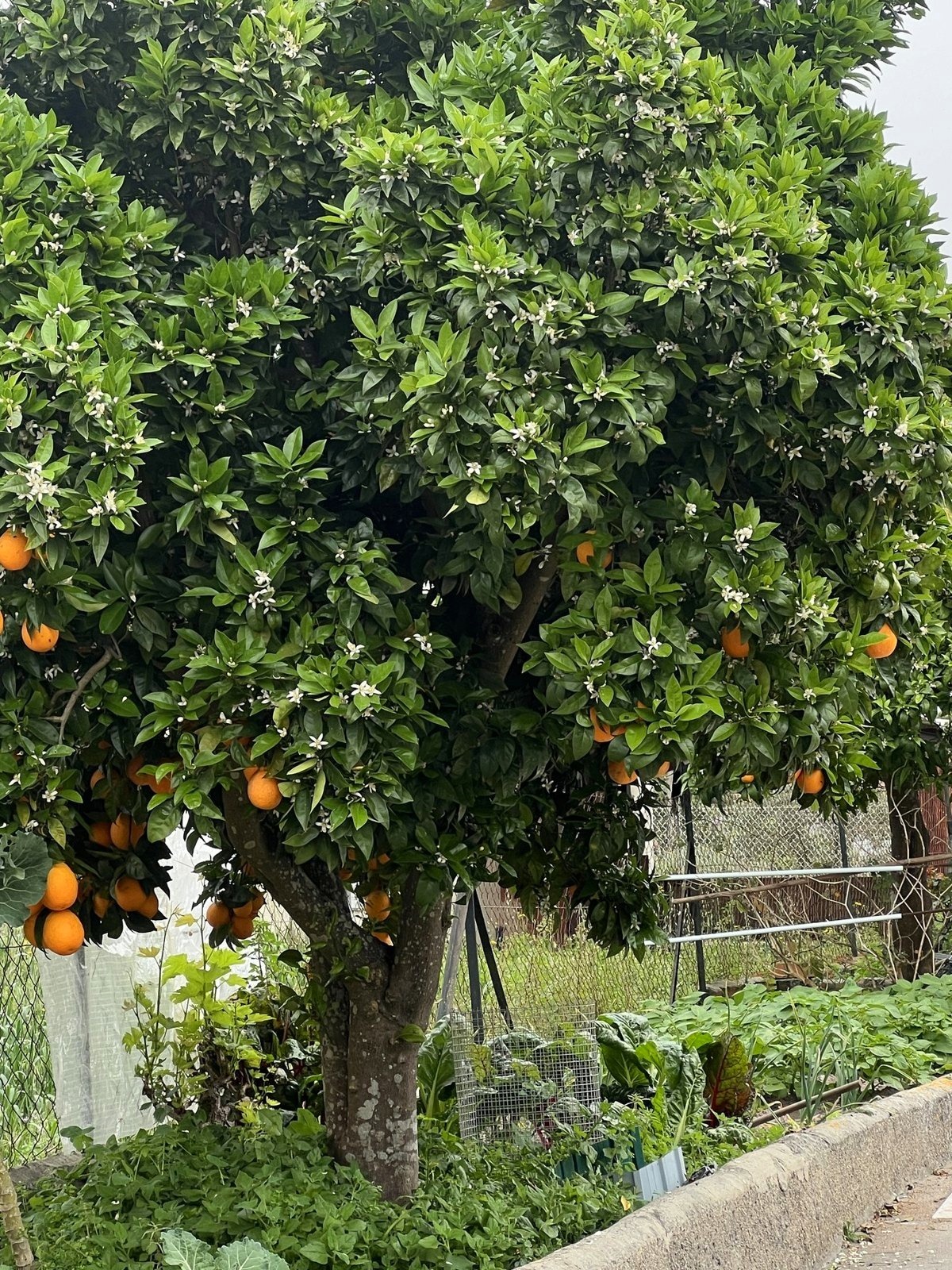

Óbidos, a walled town full of flowers
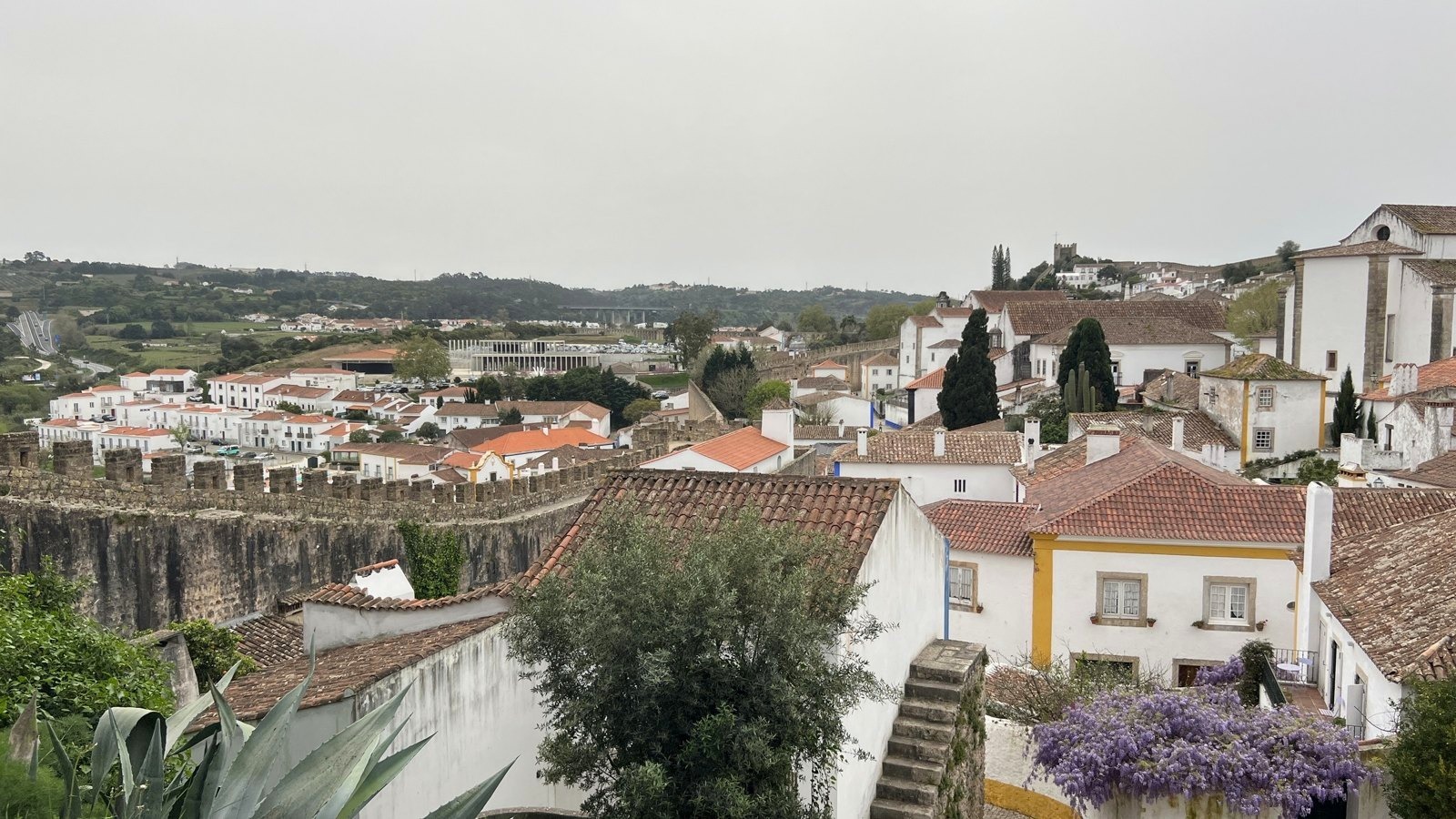
We saw it from the road first: a castle on a hill, a long wall circling it, and white houses with terracotta roofs packed inside. That was Óbidos.
According to Visit Portugal, Portugal’s first king, Afonso Henriques, took the town back from the Moors in 1148, and King Dinis later gave it to his queen, Isabel (Rainha Santa Isabel). The town and the land around it stayed in the hands of Portugal’s queens until 1883, which is why it is known as the “queens’ town.” Walking through it, I could see why: it is lovely enough to give to a queen.
We left the car outside the walls and walked in through the town gate, and the scent of flowers hit us right away. Purple wisteria hung over white walls, and houses trimmed in yellow and blue lined the cobbled lanes.

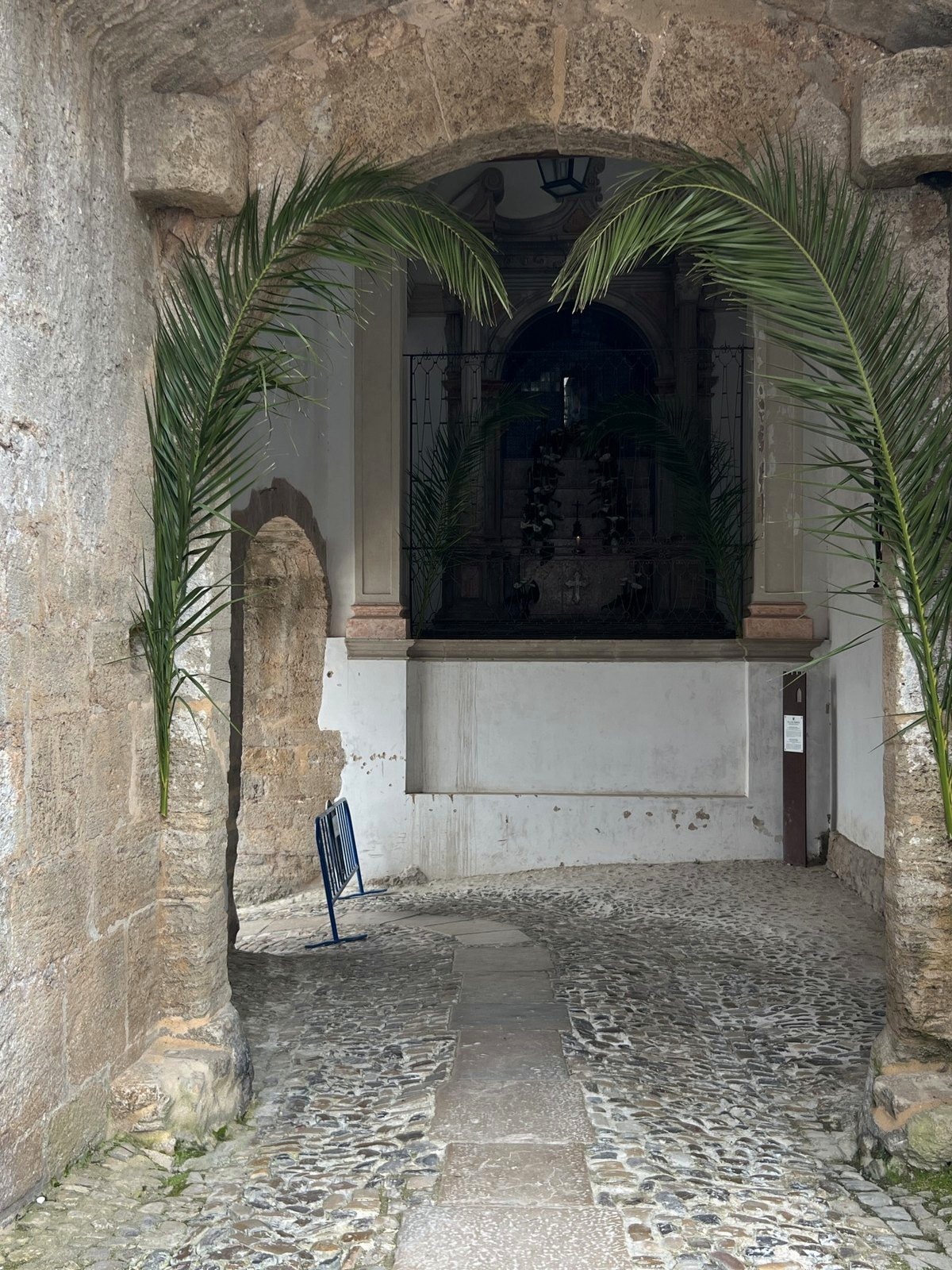
A town whose scent you want to remember
In this season the whole town smelled of flowers. I suspect that years from now, just thinking of Óbidos will bring that scent back. My wife put it this way:
“I wish there were a way to remember a scent, too.”
Our kid seemed to feel the same, picking up fallen petals all along the way and collecting them in one hand.


The wall walk with no railing
A walkway runs along the top of the wall. The wall walk around the town is about 2 km (1.2 mi) long. Up top it was narrow, and in many places there was no railing, which made my stomach drop. I was nervous the whole time, so we walked just one stretch, and I only relaxed once we were back on the ground.
After coming down we sat in a wooden-framed net hammock at a good viewpoint and looked out over the town. It was quirky seating, and a nice touch. The castle on top of the hill is now a hotel, a pousada, which is what Portugal calls a castle or monastery converted into lodging.


A coffee and a loquat tree
Before going back to the car, we rested over coffee at a café attached to a guesthouse. Meanwhile our kid noticed other tourists picking fruit off a tree and got curious. We were told it was a loquat tree, and that the fruit tastes a bit like apricot.
Óbidos and Nazaré in a day, without a car
We drove north and linked the two towns ourselves. If you don’t rent a car, day trips from Lisbon also cover both towns. These two stop in Óbidos and Nazaré (along with Fátima). We didn’t take either one, so compare group size, language and what’s included on the booking page.
Getting there
We drove from Vendas Novas: about 131 km (81 mi), roughly an hour and a half on Google Maps. The lanes inside the walls are narrow, so we left the car outside and walked in. The main street, Rua Direita, runs from the town gate (Porta da Vila) up to the castle.
Tickets and costs
We didn’t buy any tickets for the lanes or the wall walk. The only thing we paid for there was coffee, $2.72 (March 2024).
Time spent
From the first photo at the gate until we drove off, it was a little over an hour, enough for a slow walk through the lanes, one stretch of wall and a cup of coffee.
Good to know
- The wall walk is narrow, with no railing in many places. With a young child, a short stretch is plenty; spend the rest of your time in the lanes.
- In late March the wisteria was in full bloom, and the scent in the lanes was strong.
- There are viewpoints around town where you can sit and rest.
After taking in Óbidos, we got back in the car and headed for our next stop, Nazaré.
Nazaré, a fishing town and a beach of big waves
Nazaré was a small, quiet fishing village for a long time. Since the early 2010s it has been known worldwide for big-wave surfing. The big waves break at Praia do Norte (North Beach), on the north side of the headland with the lighthouse.
A late lunch and the last toy
It was a 30-minute drive from Óbidos to Nazaré. We stopped at Burger King for a late lunch. There we finally completed the Kung Fu Panda 4 toy set we’d been collecting all trip. Looking back, I think we wanted to finish it more than our kid did.
Parking in Nazaré was hard to find. We circled town several times before we spotted a space tucked away in a corner.
Calm sand on one side of the headland, rough surf on the other
The town side still looks like a fishing village. The beach promenade is known for the sight of fish drying on nets.
The beach in front of town, Praia da Nazaré, was a calm stretch of sand. But once we crossed the headland with the lighthouse, white spray kept rolling in at the north beach. It was hard to believe it was the same sea.

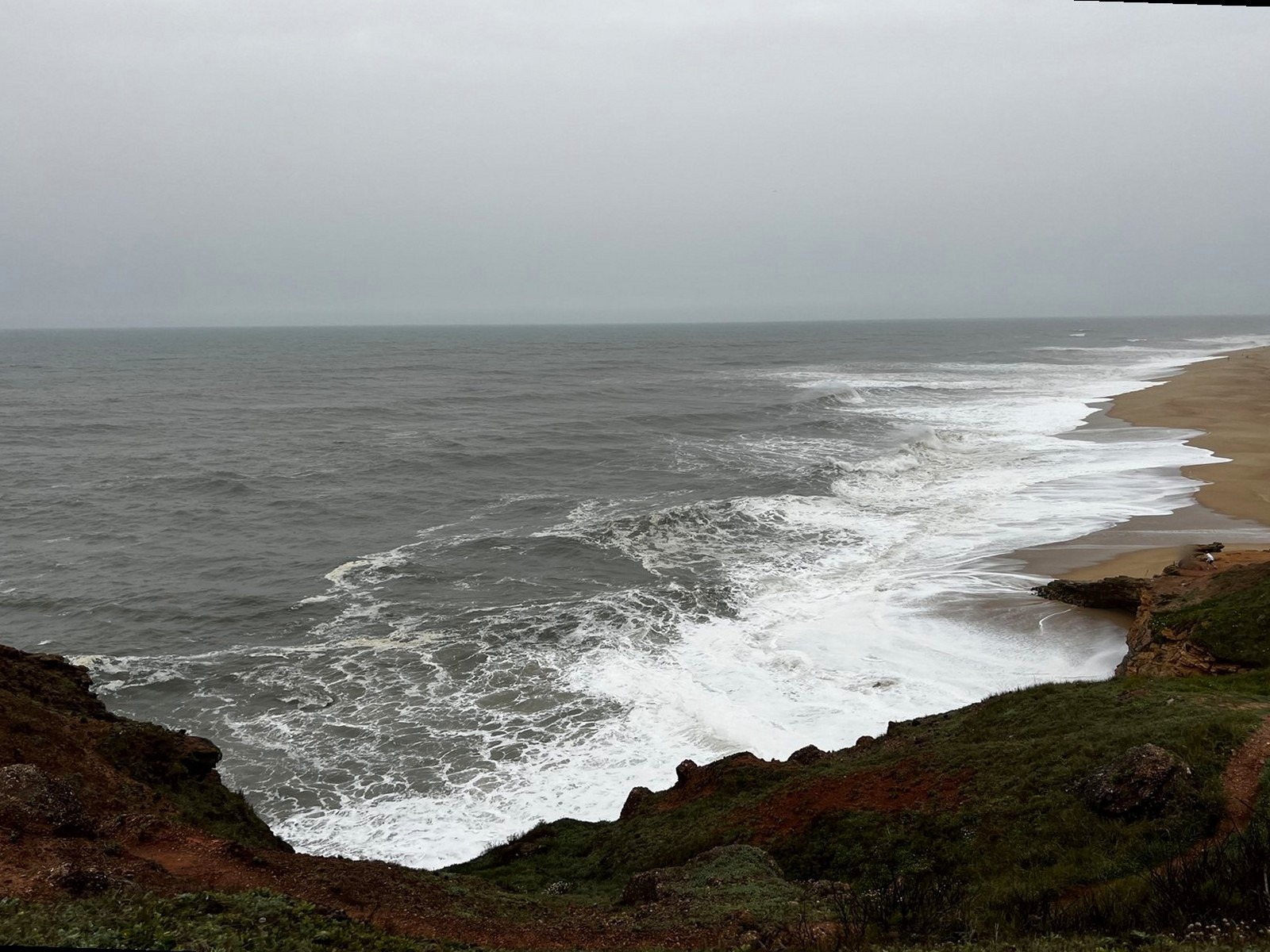
Late March is after the big-wave season, so these weren’t the monster waves from the famous photos. They were still rougher than any I had seen before. Our kid wrote in the diary that day (in Korean; this is my translation):
“The wave was about five times taller than me.”
We had tried surfing on gentle waves in Bali, so we wondered how surfers stay on their boards in waves like these. We’d love to watch them here in person during big-wave season.

The cliff trail instead of the lighthouse
On rough days, a lot of people seemed to watch the sea from the fort with the lighthouse. We followed our kid’s lead along the cliff trail by the sea, which got us a little closer to the waves. The wind was so strong that I marveled at a seagull hovering in place.
We watched for a long time as the waves came in, some of them looking like they could swallow anything in their path.


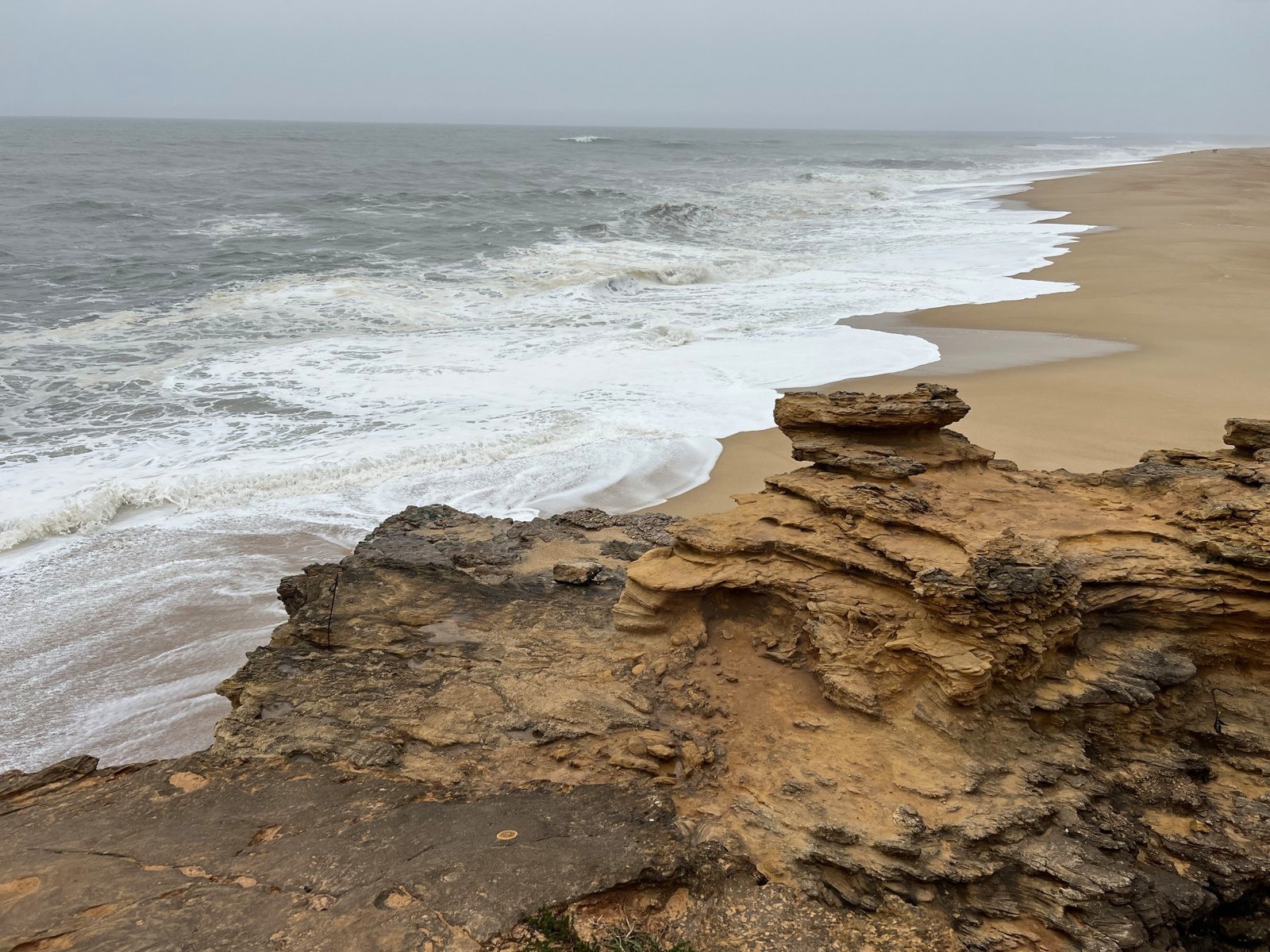
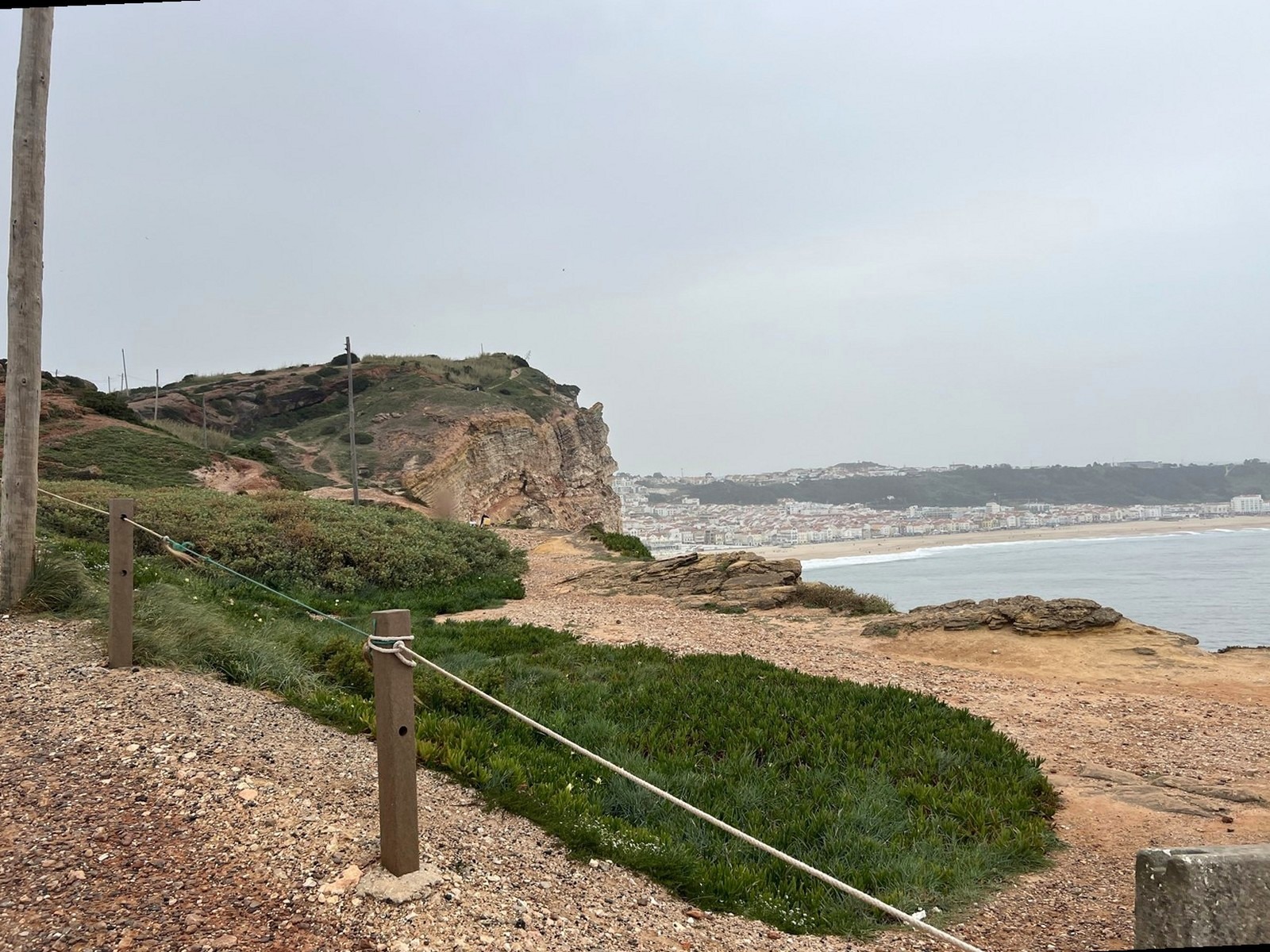
In the Nazaré wind
The wind on the cliff was strong. A light jacket that cuts the wind makes it easier to stay out by the waves longer. These aren’t the jackets we wore; the links open search results so you can compare several.
A wave T-shirt in the souvenir shop
After watching the waves, we walked down the hill into town and stopped at a souvenir shop. A T-shirt hanging in the shop showed the very sea we had just seen.

The reason the north beach is famous for big waves lies in the seabed. Offshore there is an undersea canyon about 230 km (143 mi) long and more than 5,000 m (16,400 ft) deep. The canyon amplifies incoming swells into giant waves. In 2011 the Hawaii-based surfer Garrett McNamara rode a 23.77 m (78 ft) wave here, and world records have been broken in these waters several times since. The big-wave season is said to run from November to February.
A plush sheep with a Fatima ribbon
In that shop our kid spent a long while deciding what to buy with the last of the trip’s pocket money, then spotted a small plush sheep and picked it right away. It rode in our kid’s pocket for the rest of the trip.
After buying it we noticed a ribbon on the sheep that read “Fatima.” Later we learned that Fátima, not far inland, is a famous pilgrimage site, and that it has some connection to sheep.

Getting there
From Óbidos to Nazaré was about 40 km (25 mi), 30 minutes on Google Maps. Parking is scarce in town and near the lighthouse. From where we parked, it was a short walk uphill to the cliff trail in Sítio, where you can watch the famous waves.
Tickets and costs
The cliff trail and the viewpoints by the sea have no tickets. The fort with the lighthouse (Forte de São Miguel Arcanjo) is listed on the Nazaré municipal website as open all year with a €3 admission (checked October 2026). Inside are the Surfer Wall (a display of surfers’ boards) and a center explaining the Nazaré canyon. We did not go inside the fort.
Time spent
From arriving in Nazaré and sitting down to lunch until we left the souvenir shop and got back in the car, it was about 2 hours 45 minutes. About an hour of that was on the cliff trail watching the waves.
Good to know
- The wind on the cliff is strong. With a young child, bring a jacket and hold hands near the edge.
- Even outside the big-wave season (November–February), the surf at the north beach was rough. Going from the town beach to the north beach makes the contrast clear.
- Parking can take a while, so leave some slack in your schedule.
The road to Coimbra, and a night there
We left Nazaré and drove toward Coimbra on a highway as the sun went down.
At about 8:30 p.m. we checked into NH Coimbra Dona Inês, a four-star hotel in the city. For dinner we went to GO CHEF, a buffet a little way out of town, as we had the night before in Évora, and ate well. I’ll cover Coimbra in a separate post.

Places to stay in Coimbra
We booked each night as we went, but if you plan ahead, these are worth a look.
Before you go
Hours and season
| Place | Hours and season |
|---|---|
| Nazaré lighthouse fort (Forte de São Miguel Arcanjo) | Open all year, admission €3 |
| Nazaré big-wave season | November to February; varies day to day with sea conditions |
| Óbidos town and wall walk | No admission charged when we went (a Sunday around midday) |
Checked October 2026
Costs for the day
| Place | What | Amount (USD) |
|---|---|---|
| Lidl, Vendas Novas | Snacks | 18.12 |
| Café at an Óbidos guesthouse | Coffee | 2.72 |
| Burger King, Nazaré | Late lunch (two charges) | 37.49 |
| Nazaré souvenir shop | Plush sheep (our kid’s pocket money) | No card record |
| Buffet on the edge of Coimbra | Dinner | 59.24 |
Amounts charged to our card, tax included; transportation not included. March 2024 prices
Words worth knowing
| Term | Meaning |
|---|---|
| Big-wave surfing | Surfing the biggest waves. At Nazaré, jet skis sometimes tow surfers into the wave |
| Pousada | A Portuguese lodging in a converted historic building such as a castle or monastery. Óbidos castle is one |
| Sítio | The clifftop neighborhood above Nazaré beach, on the way to the lighthouse fort |
Q&A at a glance
Can you see Óbidos and Nazaré in one day?
The two towns are 30 minutes apart by car, so they pair up well in a day. Driving north from Vendas Novas, we spent midday in Óbidos, about 2 hours 45 minutes in Nazaré, and reached Coimbra in the evening.
Can you walk the Óbidos wall with a child?
You can, but it is narrow and there’s no railing in many places. We walked just one stretch and came down. If your child is young, keep it short.
When can you see the big waves in Nazaré?
The big-wave season is known to run from November to February. Even then the sea changes from day to day. Late March, when we went, was after the season, so we saw nothing record-breaking, but the surf at the north beach was still plenty rough.
Do you have to go inside the Nazaré lighthouse fort?
We didn’t go in; we watched the waves from the cliff trail outside. Inside the fort are a display of surfers’ boards and a center explaining the canyon, and admission is €3 (checked on the Nazaré municipal website, October 2026). It looks worth a stop if you’re interested in the surfing story, though we can’t say from experience.
Is parking in Nazaré difficult?
Even in March, on a Sunday afternoon, we circled town several times before finding a space. Plan to park a bit farther out and walk.
Wrap-up
- Time spentAbout an hour in Óbidos and 2 hr 45 min in Nazaré (about an hour of it watching waves)
- CostWe paid no admission at either place (the Nazaré fort charges €3; we skipped it). What we bought is in the cost table above (March 2024 prices)
- Good forFamilies driving north from Lisbon or the south toward Porto; anyone who wants a walled town and a wild sea in one day
- If we went backIn Óbidos, I’d take more time over the castle, the lanes and the shops. In Nazaré, I’d return on a clear day to stare at the waves for a while, and go into the lighthouse fort we skipped this time.
The day began with the scent of flowers and ended with waves. As my wife said, there was no way to hold on to the scent of Óbidos’s lanes, but our kid kept picking up petals and collecting them in one hand all the way. The Nazaré waves, in our kid’s words, were about five times taller than our kid, and the little sheep bought on that shore stayed in a pocket until the trip ended. Back then our kid brought home a plush toy from everywhere we went. Thinking of that sheep now, I realize how quickly the years have passed.
Planning a trip to Portugal?
Óbidos and Nazaré fit neatly into one day on a drive north from Lisbon. Compare flights and rental cars here, and pick up a guidebook to read before you go.
Related posts
| Full itinerary | 2-week Portugal itinerary: a road trip from Lisbon through the Algarve to Porto Our 13-night route and the day-by-day plan |
|---|---|
| Previous post | Alte waterfall’s red cliffs and green water, then the cork-oak road to the Chapel of Bones and the Roman temple in Évora Day 7 of the trip |
Sources checked 6
- Visit Portugal, Óbidos Afonso Henriques in 1148, King Dinis’s gift to Queen Isabel, the queens’ ownership until 1883, the castle as a pousada(checked October 2026)
- Turismo Centro de Portugal, Óbidos A 2 km wall walk, Rua Direita from the town gate to the castle(checked October 2026)
- Turismo Centro de Portugal, Nazaré Big Waves Big-wave season from November to February, canyon length and depth, surfing records(checked October 2026)
- Visit Portugal, Praia do Norte, Nazaré The canyon and the big waves(checked October 2026)
- Câmara Municipal da Nazaré, Forte de São Miguel Arcanjo Open all year, €3 admission, Surfer Wall and canyon center(checked October 2026)
- Google Maps route calculation (October 3, 2026): Vendas Novas → Óbidos → Nazaré → Coimbra
Discover more from Elsewhere, Mostly
Subscribe and get new posts sent straight to your inbox.