This post contains affiliate links. If you book or buy through them, I earn a commission at no extra cost to you. As an Amazon Associate I earn from qualifying purchases.
In this post One long driving day from the Algarve up to Vendas Novas, with two stops on the way. We saw Alte waterfall spill between red cliffs into a green pool, drove the cork-oak roads of the Alentejo, and walked the walled town of Évora: the Chapel of Bones, the Roman temple and the Portas de Moura fountain.
TownsSightsFoodOvernightBy car
March 23Sat · Day 7 · Albufeira → Vendas Novas
- AlbufeiraChecked out of the beach resort
- Albufeira → Alte · about 36 km (22 mi)
- Gas station Filled up the tank
- AlteSmall village in the Algarve hills
- Alte waterfallAbout an hour by the water
- Village river beachTrees wrapped in knitting
- Alte → Évora · about 189 km (117 mi) of cork-oak country
- ÉvoraOld town on foot, car parked outside the walls
- Chapel of BonesPlus the museum upstairs
- BakeryPastries and coffee
- Cathedral, Roman temple
- Portas de Moura fountain
- Asian buffet restaurantDinner on the edge of town
- Évora → Vendas Novas · about 57 km (35 mi)
- Vendas NovasOne night at a B&B
| When | Saturday, March 23, 2024, day 7 of our Portugal trip |
|---|---|
| Weather | Overcast in Alte, blue sky breaking through over Évora in the afternoonWarm sun and a cool breeze |
| Driving | About 280 km (174 mi), roughly 3 hr 25 min behind the wheel |
| Admission | PaidChapel of Bones, Évora €7 adults, €15 family ticketNo ticketAlte waterfall, Alte village, Roman temple, cathedral (outside), Portas de Moura fountain |
| Who | The three of us: my wife, our kid and me |
| Where we slept | One night at MIX inn, a B&B in Vendas NovasAbout 57 km (35 mi) west of Évora, on the way to the next day’s stop, Óbidos |
| Where | Alte a small village in the hills of the AlgarveÉvora a walled town on the Alentejo plain; its old town is a UNESCO World Heritage SiteVendas Novas a small town between Évora and LisbonGoogle Maps links are collected under “Where everything is,” near the end. |
In this post
After two days on the Algarve coast, we pointed the car north on day 7. It turned out to be the longest drive of the whole trip. We stopped at a waterfall in the hills behind the coast, crossed the Alentejo plain on roads lined with cork oaks, and reached the walled town of Évora, where the first thing we did was the one I’d really wanted to see: the Chapel of Bones. Then the Roman temple, a fountain, dinner, and a bed in Vendas Novas, a town on the next day’s route.
Below, everything is in the order we did it, with how to get there and what’s worth knowing at each stop.
March 23Albufeira to Vendas Novas about 280 km (174 mi)
- 1Albufeira around 11:45 a.m.Checked out of the beach resort and set off
- 2Alte around 12:35 p.m.Waterfall and village river beach, about an hour
- 3Évora around 4:20 p.m.About two and a half hours in the old town on foot, then a buffet dinner on the edge of town
- 4Vendas Novas nightOne night at a B&B
Numbers mark towns and villages, 🍽 is where we had dinner, and the small white dot is a quick stop. Dotted lines show the drive. It’s a sketch, so real distances and directions differ a little.
Why we picked Alte waterfall over Benagil and Sagres
We left our resort in Albufeira around 11:45 a.m. The original plan for the day had been a boat trip to the Benagil sea cave. But we’d spent the day before in Lagos, up close with rock pillars, arches and caves, and we were told that at this time of year the boats only loop through the caves without letting anyone off. The promise of maybe seeing dolphins didn’t quite tip the balance.
We also skipped Sagres, at the far western tip of the Algarve. A few days earlier we’d stood on the cliffs of Cabo da Roca looking out over the Atlantic, and another clifftop cape felt like a repeat. Instead I looked for something on the way north to Évora, and that’s how we ended up at a waterfall near Alte, a small village inland. I wrote up the Benagil rule changes and off-season boat trips in our 2-week Portugal itinerary.
As soon as we turned inland from the coast, nearly every garden along the road had orange and lemon trees heavy with fruit. Around 12:15 p.m. we stopped for gas and then headed for Alte.
Alte waterfall: red cliffs and green water
At Alte waterfall (Queda do Vigário), a ribbon of water drops between red hillsides into a green pool. Red earth cliffs, dark green trees on top, white falling water and a jade-colored pool, all in one frame: the colors were lovely. In a dry spell, apparently, you can find nothing but a bare cliff. On our day there was plenty of water in both the fall and the pool, and that color is what I still remember.
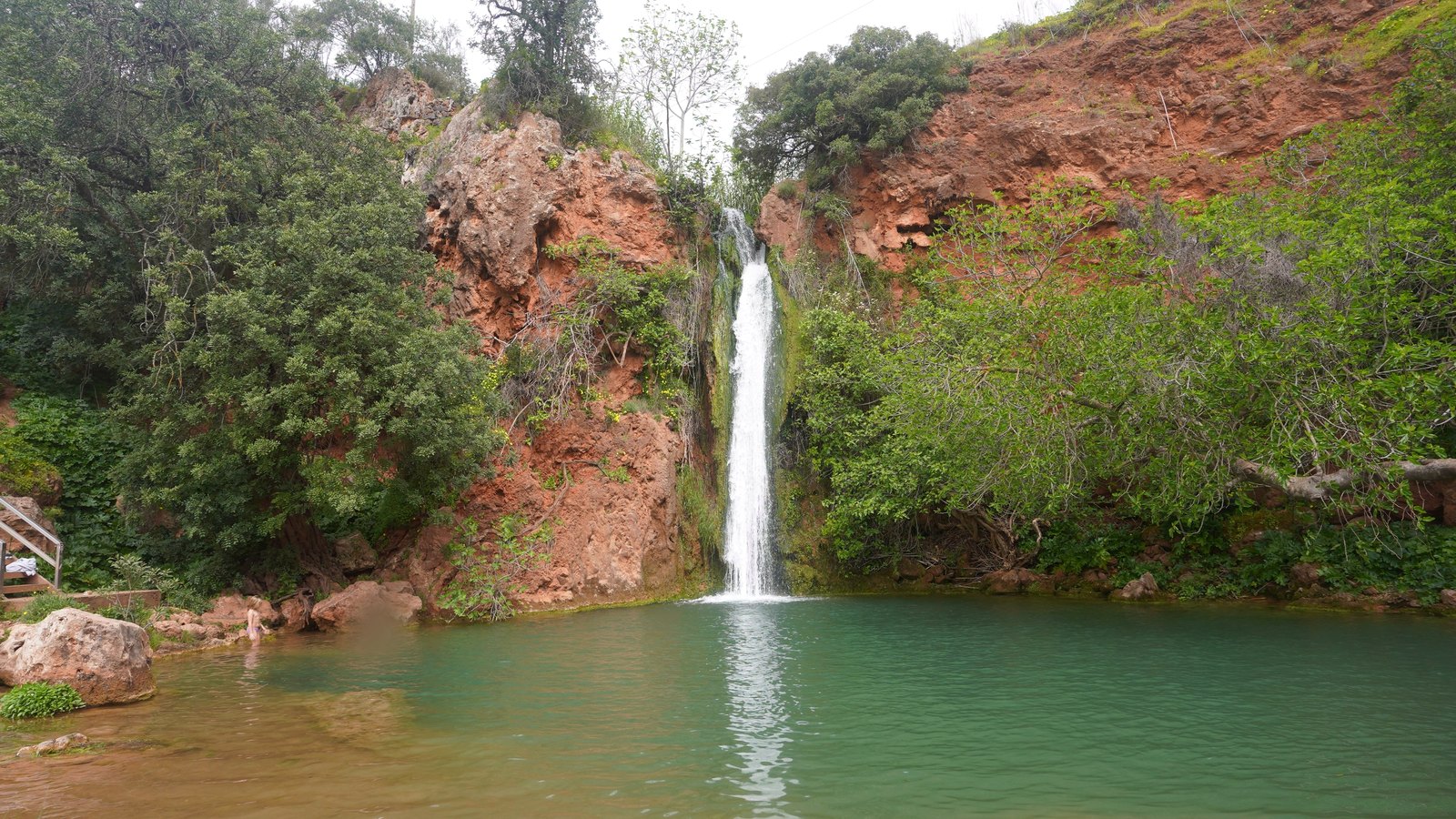
We parked in a lot above a big orange grove and went looking for the falls. At first we couldn’t find the way in and had to ask several people. There turned out to be two routes: a footpath that loops around the orange grove, and a set of wooden steps that goes straight down to the waterfall. To save time, we took the steps.

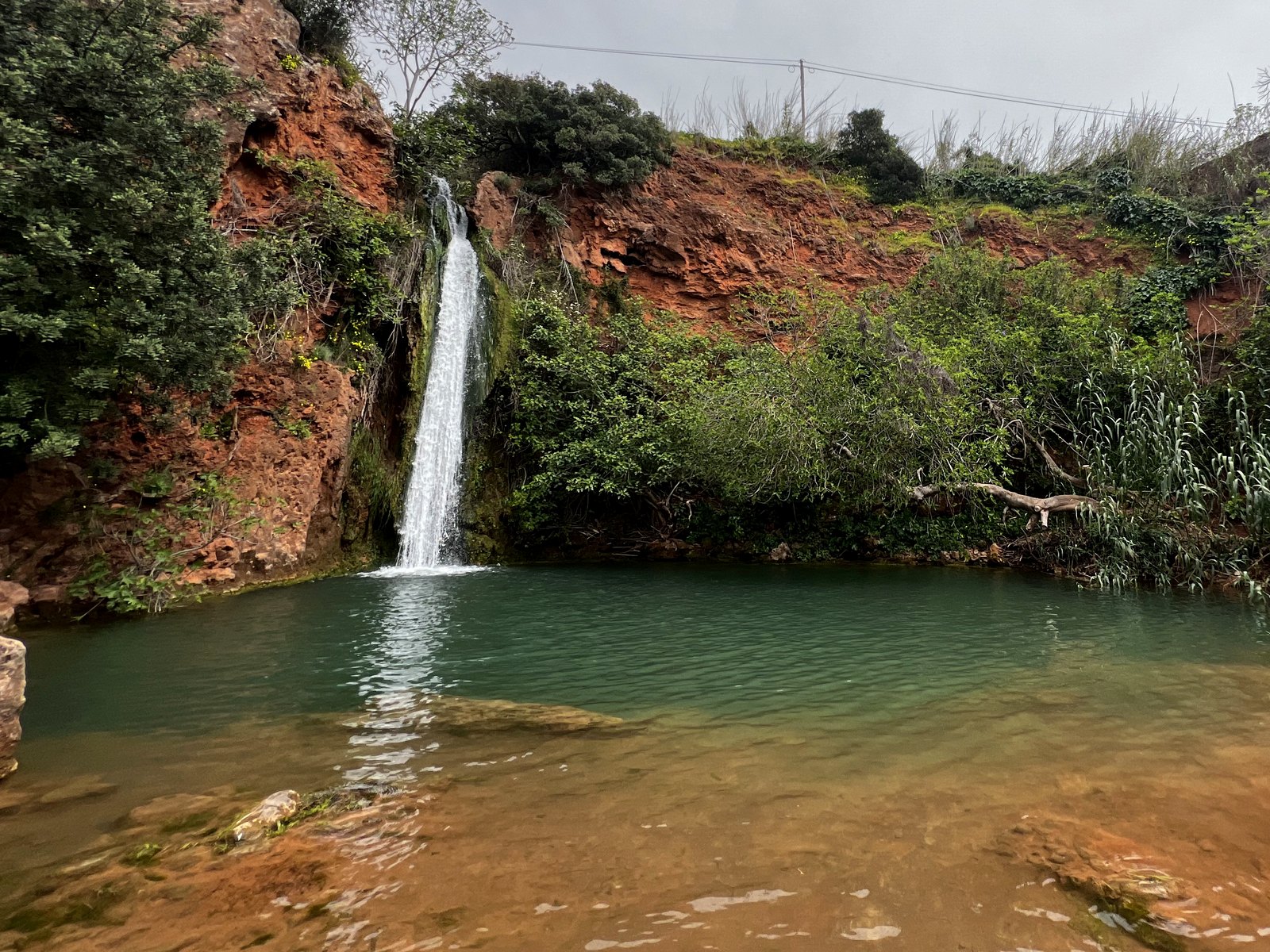
The sun was warm and the breeze was cool. My wife and I sat at the edge with our feet in the water and watched the falls for a long time. Our kid, who loves finding any living thing outdoors, was already in a swimsuit at the water’s edge right in front of us, catching tadpoles and letting them go. Before we left, our kid offered to take a photo of the two of us, and a finger kept creeping over the lens, shot after shot. We couldn’t stop laughing.
A camera sized for small hands
If your child wants to take their own photos on the trip, there are small, light cameras made for kids. The link opens search results so you can compare several models.
Getting to Alte waterfall and what to bring
- Distance: About 36 km (22 mi) from our resort in Albufeira, roughly 36 minutes by car (Google Maps, typical traffic, checked October 2026)
- Parking and the way in: The Loulé tourism site says to park next to the village cemetery and walk down either the wooden steps or a dirt path of about 300 m (1,000 ft). The entrance isn’t obvious; of the two routes, the wooden steps take you straight to the falls.
- The falls: The water drops about 24 m (79 ft). In summer plenty of people swim in the pool, but it’s a natural pool, not a managed swimming area, so stay right beside kids who go in.
- What to bring: The bank is red earth and stones. If you plan to get in, keep swimsuits, towels and water shoes in the car.
Water shoes and kids’ swimwear
At a spot like Alte, where the bottom is dirt and stones, water shoes make it much easier to keep your footing. Pack a pair for the adults and one for the kids, and you’ll use them at the beach and the pool too. These aren’t shoes we bought; the links open search results so you can compare several pairs at once.
Alte village: a river beach and trees in sweaters
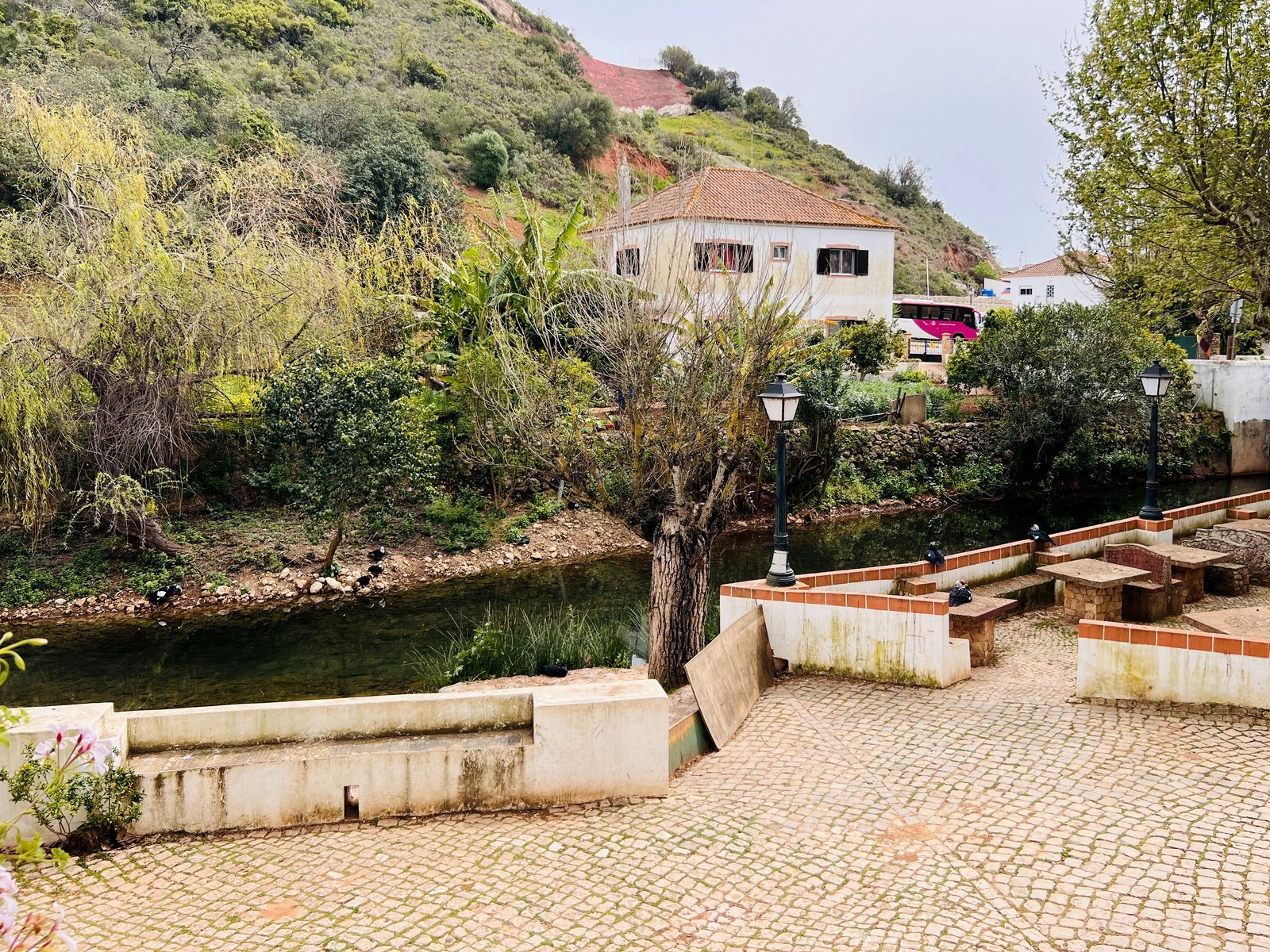
Around 1:30 p.m. we walked down into the center of the village. Little Alte has a long stretch of riverside called the Praia Fluvial de Alte, a river beach where people cool off in summer. When we were there the water was low and the way down was closed off, so we only looked from above.
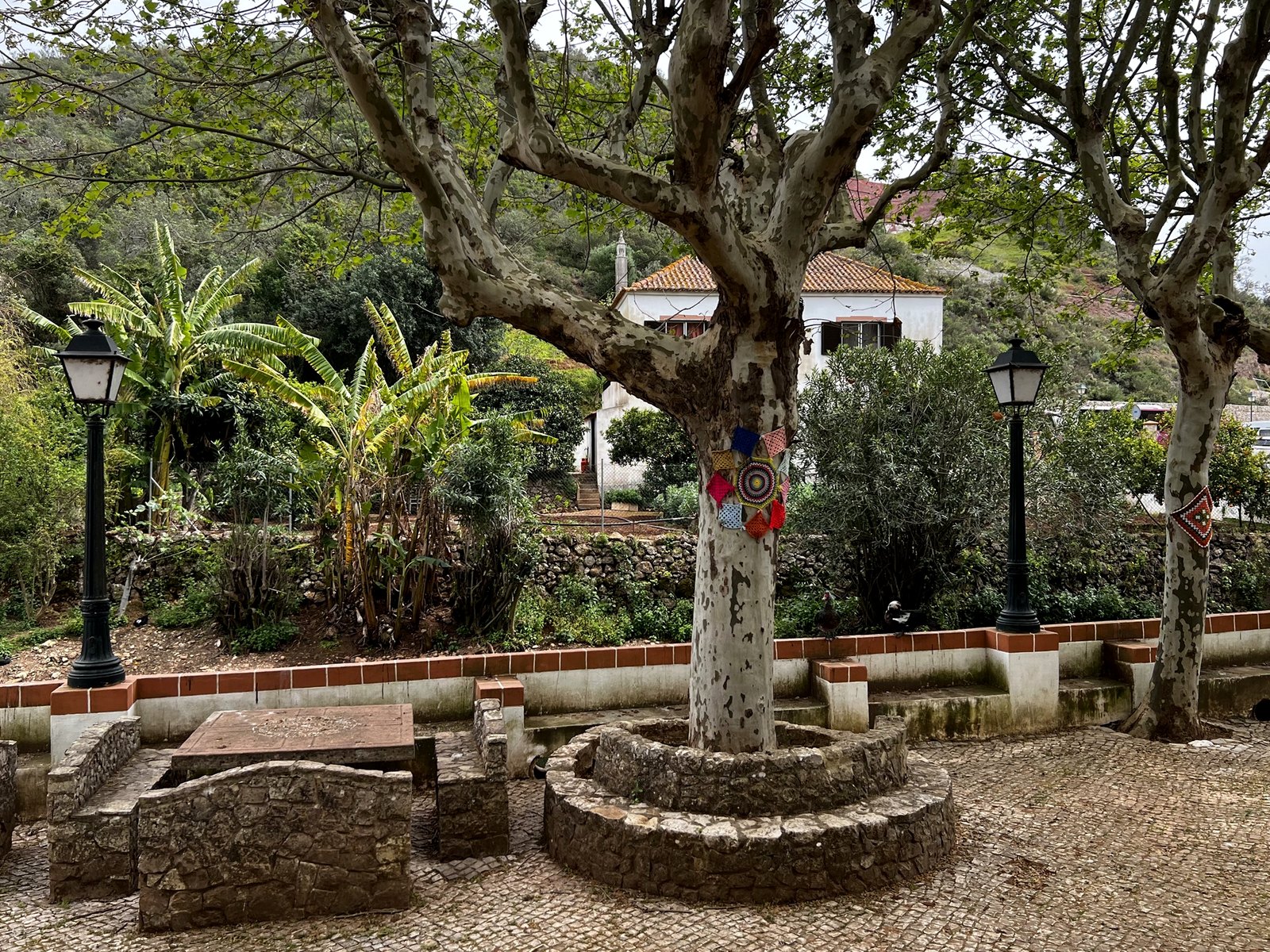
In the village we met ducks we’d never seen before: white heads, red around the eyes, black bodies with white patches. The plane trees had knitted fabric wrapped around their trunks. We’d hoped for a coffee before moving on, but few places were open, so we got back on the road.
Along the cork-oak roads into the Alentejo
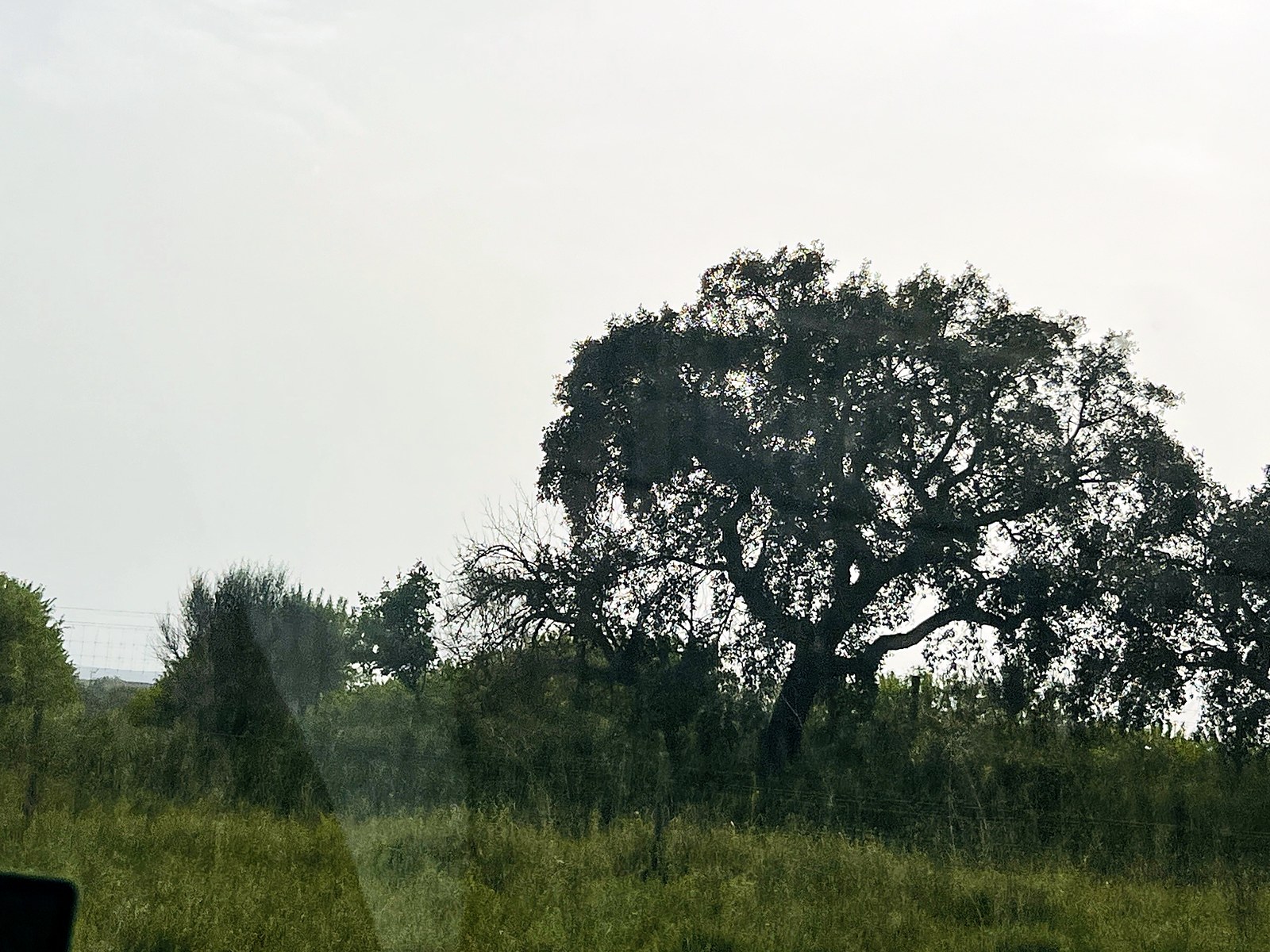
From Alte to Évora is about 189 km (117 mi), a little over two hours on Google Maps. Once we crossed the Algarve hills onto the Alentejo plain, cork oaks lined both sides of the road.
Portugal produces about half of the world’s cork. The trees aren’t cut down; only the bark is stripped. The first harvest comes about 25 years after planting, and after that the bark is taken every nine years. Each stripped trunk gets a number painted on it to mark the year, so the growers know when the next harvest is due. Spotting numbered trees out the window turned into a nice little game on a long drive.
I wrote about our rental car (picked up in Lisbon, dropped off in Porto) and the toll transponder in Getting around Portugal in two weeks.
Évora on foot, with the car left outside the walls
We reached Évora around 4:20 p.m. Traces of Roman and medieval times sit side by side here, and the whole old town inside the walls was added to the UNESCO World Heritage list in 1986 as the Historic Centre of Évora. Streets inside the walls are narrow and street parking is metered with time limits, so we left the car in a big parking area outside the walls and walked in. That way we didn’t have to watch the clock. We walked everything, from the Chapel of Bones to the bakery and the souvenir street, the cathedral, the Roman temple and the Portas de Moura fountain, and were back at the car around 6:45 p.m., about two and a half hours later.
Évora old townOur walk about 2½ hours
The dotted line is our walk, numbers show the order of our stops, and white dots are places we passed. It is a sketch, so the real lanes twist more than this.
The Chapel of Bones in Évora, a small chapel lined with human remains
The Chapel of Bones (Capela dos Ossos) was a place I’d made a point of seeing on this trip. It’s a small chapel inside the Church of São Francisco (Igreja de São Francisco). You walk through the wide arched porch at the front of the church to reach the ticket desk.
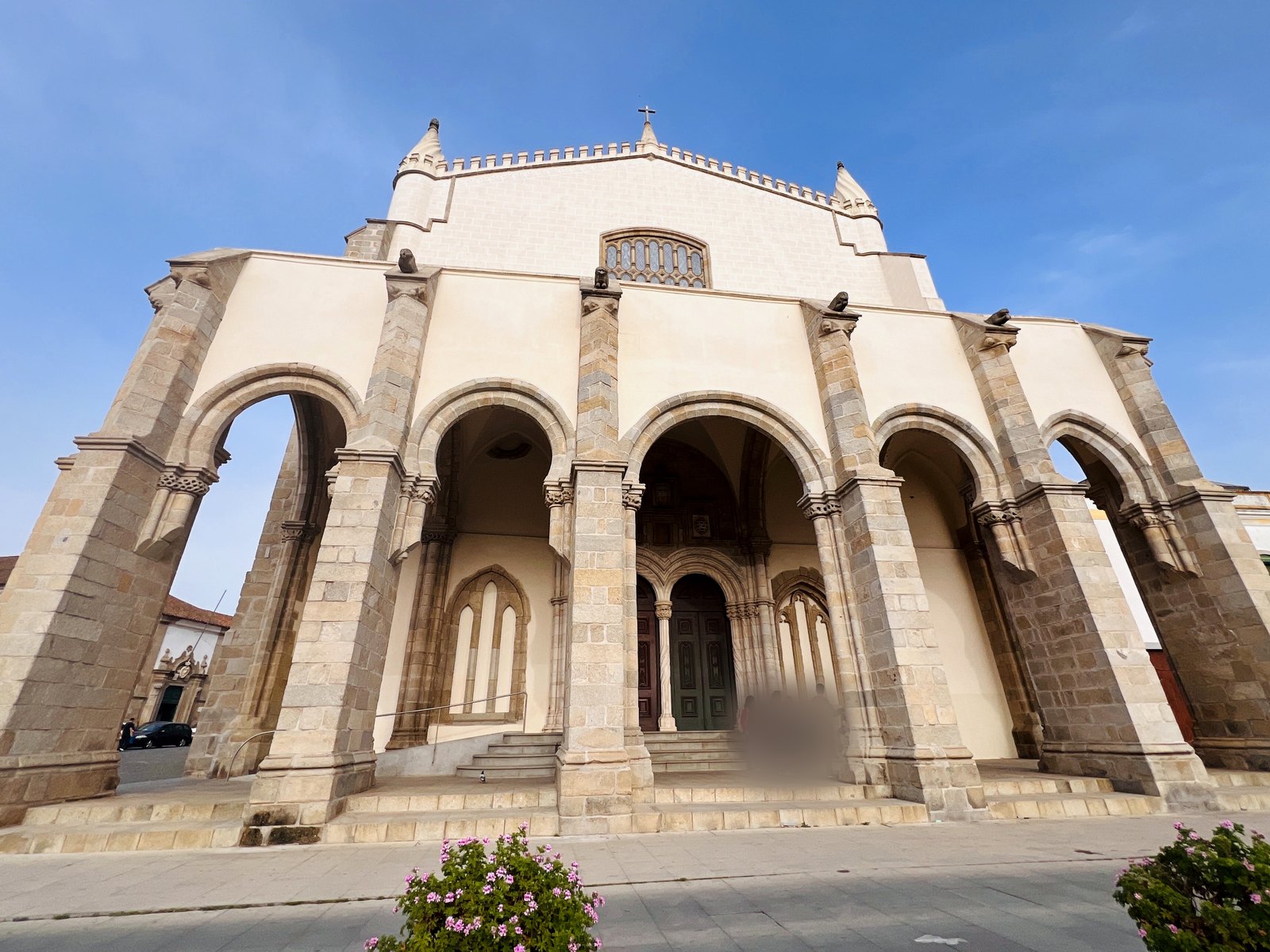

Who built a chapel out of bones, and why
According to the panel inside, the chapel was built in the first half of the 17th century and is the oldest bone chapel in Portugal. It started as a place to pray for the souls in purgatory and later became a chapel for the Senhor dos Passos, Christ carrying the cross. The bones are thought to come from people buried in the monastery’s cemeteries, the church and the cloister. Évora’s residents liked to choose this monastery as their last resting place, and being buried in a Franciscan habit was believed to bring forgiveness of sins. When burial space ran out, the friars decided to use the old remains on the chapel walls.
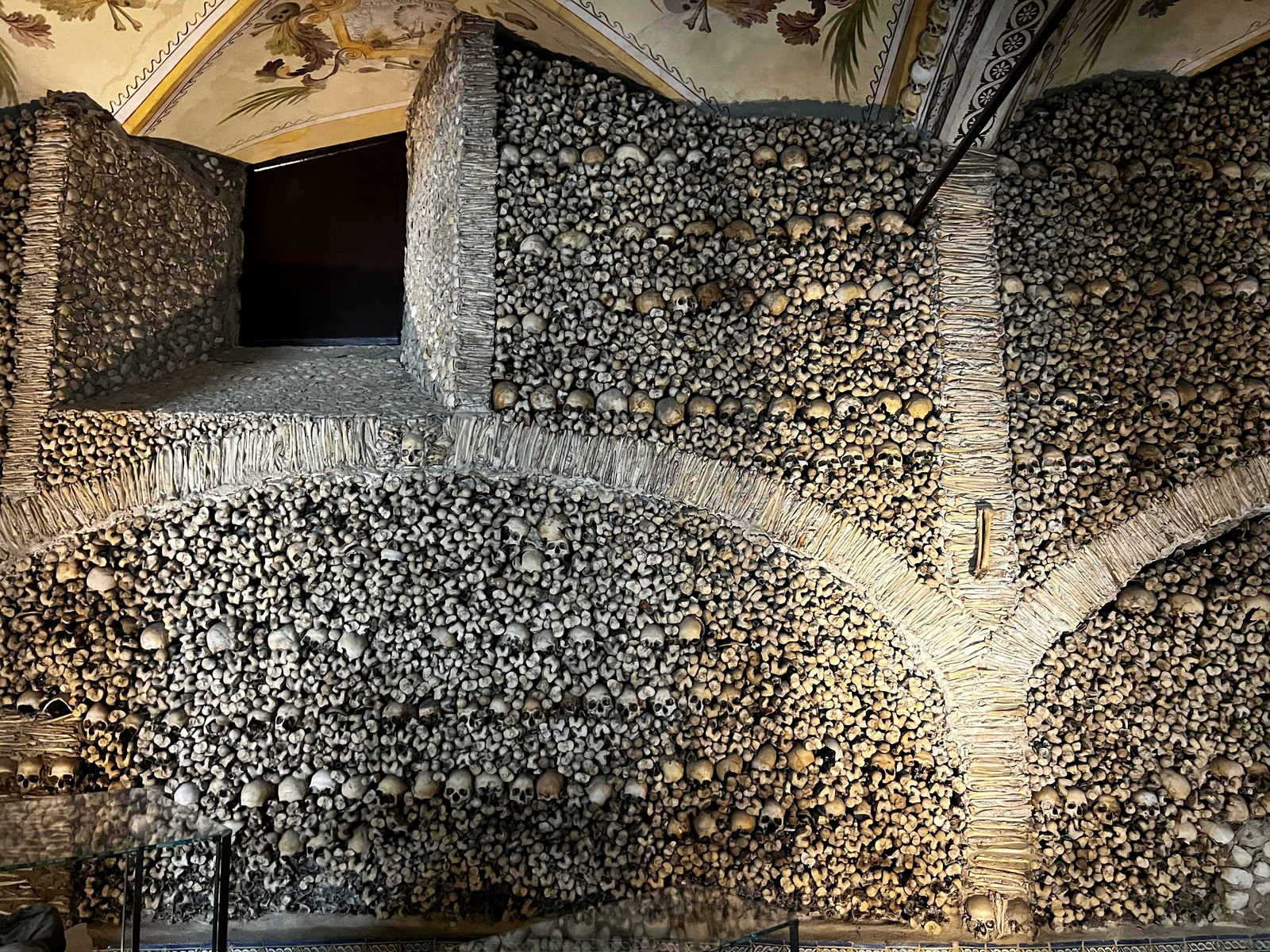
In person it was much stranger than I’d imagined. Apart from the ceiling and the floor, every wall and all eight pillars are packed with skulls and bones. It’s often said there are more than 5,000 skeletons here. The vaulted ceiling still has its frescoes, which the church’s official site says were painted in 1810. A large “1810” carved high on one wall points to the same year.


The words over the door and a poem for passersby
Above the chapel entrance is this inscription: “Nós ossos que aqui estamos pelos vossos esperamos.” Roughly: we bones that lie here are waiting for yours. The panel inside links it to the words spoken every Ash Wednesday, “Remember that you are dust, and to dust you shall return.” In other words, the chapel reminds you how short life is before you’ve even stepped inside.
To the right of the entrance hangs a poem by António da Ascensão Teles, prior of the monastery from 1845 to 1848. It asks the traveler hurrying past to stop for a moment, to think of the many who have already left this world and of the same end that waits for us all, and it says that the longer you pause, the further you go. I read it aloud to our kid, who listened with a very tense face and kept turning it over for a long while afterward. Seeing gaps here and there where bones were missing from the walls and pillars, our kid decided those were spots being kept open for each of us, and said that gave them goosebumps.
The two mummies that hung on the wall
At the back of the chapel, two mummified bodies lie in a glass case. The panel says there are records of mummies hanging on the wall as far back as the 18th century, and these two hung there, touching neither ground nor sky, until the early 2000s. That gave rise to a legend: a father and son who had treated the mother cruelly, and whom she cursed before she died, wishing that the earth of their graves would never let them decay. Science tells a different story. Both turned out to be female, and in 2019 researchers from the University of Évora announced they were an adult woman and a girl of about two and a half.
The museum and balcony upstairs
The same ticket gets you into the religious art collection upstairs: Renaissance and Baroque sculpture and painting, church ornaments, and a large number of nativity scenes, big and small. A presépio is a nativity scene with little figures around the stable where Jesus was born, and one here looks like the whole of Évora rebuilt in miniature. Our kid and I spent a long time peering at tiny scenes built inside nutshells. The outdoor balcony on the third floor isn’t high, but it’s high enough to look out over the white walls and orange roofs of the town.


Tickets and the order we went in
We bought our tickets at the church desk. One ticket covers the Chapel of Bones, the museum upstairs, the nativity collection and the terrace, and the main church itself is free. We saw the chapel first, then went up through the museum and out onto the balcony, and were back outside around 5:10 p.m. Hours and prices are under “Good to know,” below.
Seeing Évora without a car
We drove ourselves, but there are day trips to Évora from Lisbon, and walking tours that start right in town. The Chapel of Bones, the cathedral and the Roman temple are all close together in the old town, so a single day covers them. Group size and what’s included vary, so compare them on the booking page before you choose.
A bakery on the square and a street full of cork
Out of the chapel, around 5:20 p.m., we picked up a few pastries and coffees at Aqui Há Pão, a bakery on the square, and ate as we walked. The pastries looked sweet but tasted plainer than expected, which split the verdict between my wife, who has a sweet tooth, and me, since I don’t. Coffee, here as everywhere in Portugal, was very cheap.
On the way to the Roman temple we passed a street lined with souvenir shops. This is cork country, and hats, trivets, bags and wallets made of cork spilled out onto the sidewalk. We bought cork postcards, a cork trivet and a few small gifts to hand out at home. None of it was expensive. The trivet had such a pretty pattern that it never went near a hot pot; it sits out as decoration.


Cork for the kitchen table
Cork trivets and coasters like the ones in Évora’s shops are easy to find online. These aren’t the exact ones we bought, but they’re handy under a hot pot or a mug. The links open search results so you can compare several at once.
Évora Cathedral and the Roman temple
Pastries in hand, we wandered the lanes and reached Évora Cathedral (Sé de Évora) around 5:40 p.m. It sits on the highest point in town, so it’s easy to find, and from nearby you look down over white walls and orange roofs. It’s the largest medieval cathedral in Portugal, begun in 1186 and finished in the mid-13th century, with decoration added over the centuries that followed. It was too late to go in, so we only saw it from outside.


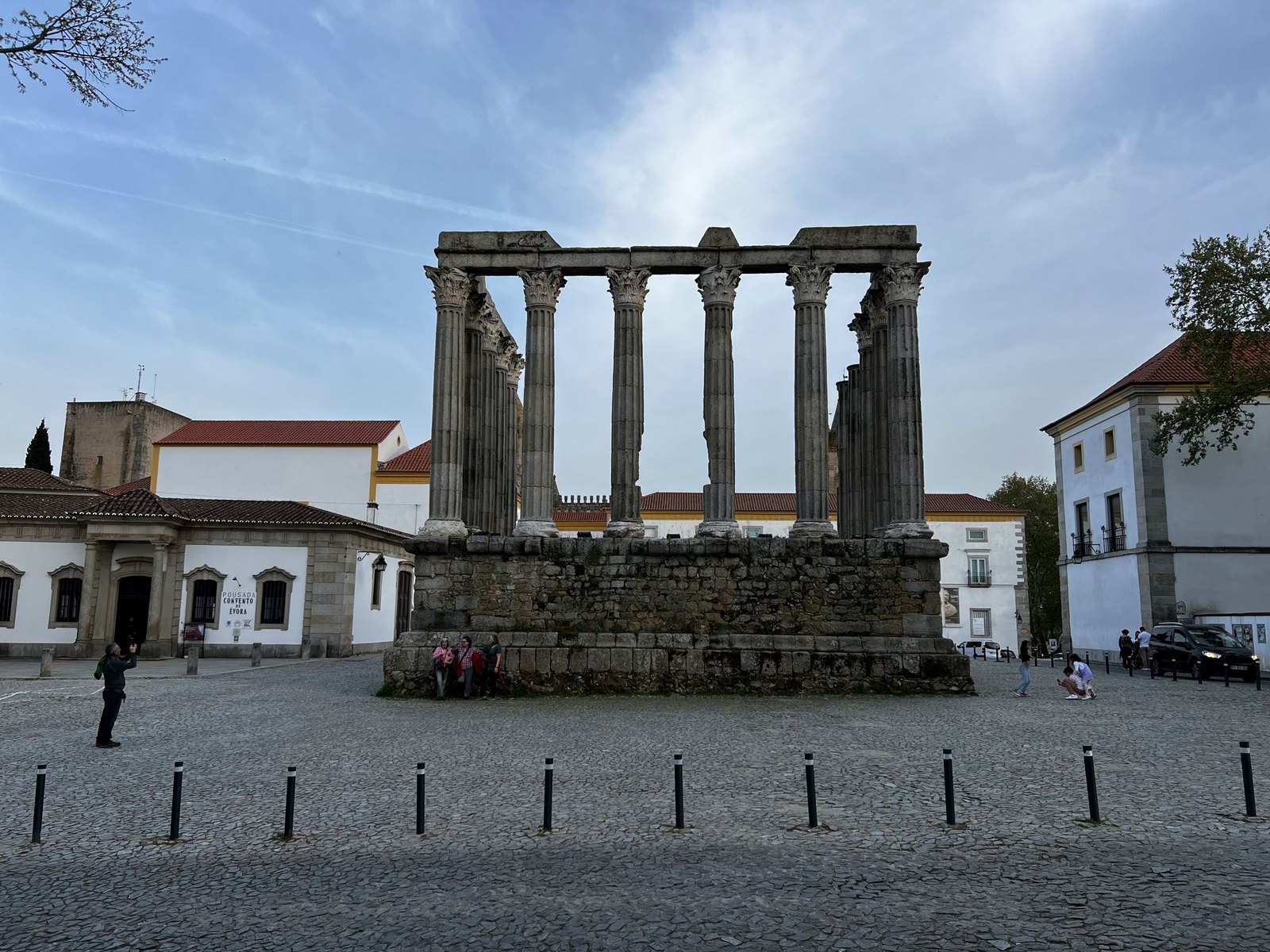
The Roman temple (Templo Romano) stands right by the cathedral. Ever since a history unit at school before the break, our kid had been fascinated by anything the Romans left behind, so finding a Roman temple out here on the western edge of the Iberian Peninsula meant more to us than it might have.
The temple is believed to have been built in the 1st century to honor Augustus, the first Roman emperor. For a long time it was called the Temple of Diana, goddess of the hunt, a name that apparently comes from a 17th-century story. It was damaged in the 5th century by the Germanic peoples who came into the region, built into a castle tower in the Middle Ages, and used as a butcher’s shop from the 14th century until 1836. I liked the idea that all those odd jobs are what kept a temple to the Roman gods standing while the town became Christian. In the late 19th century the later additions were stripped away, and the Corinthian columns you see today came back into view.
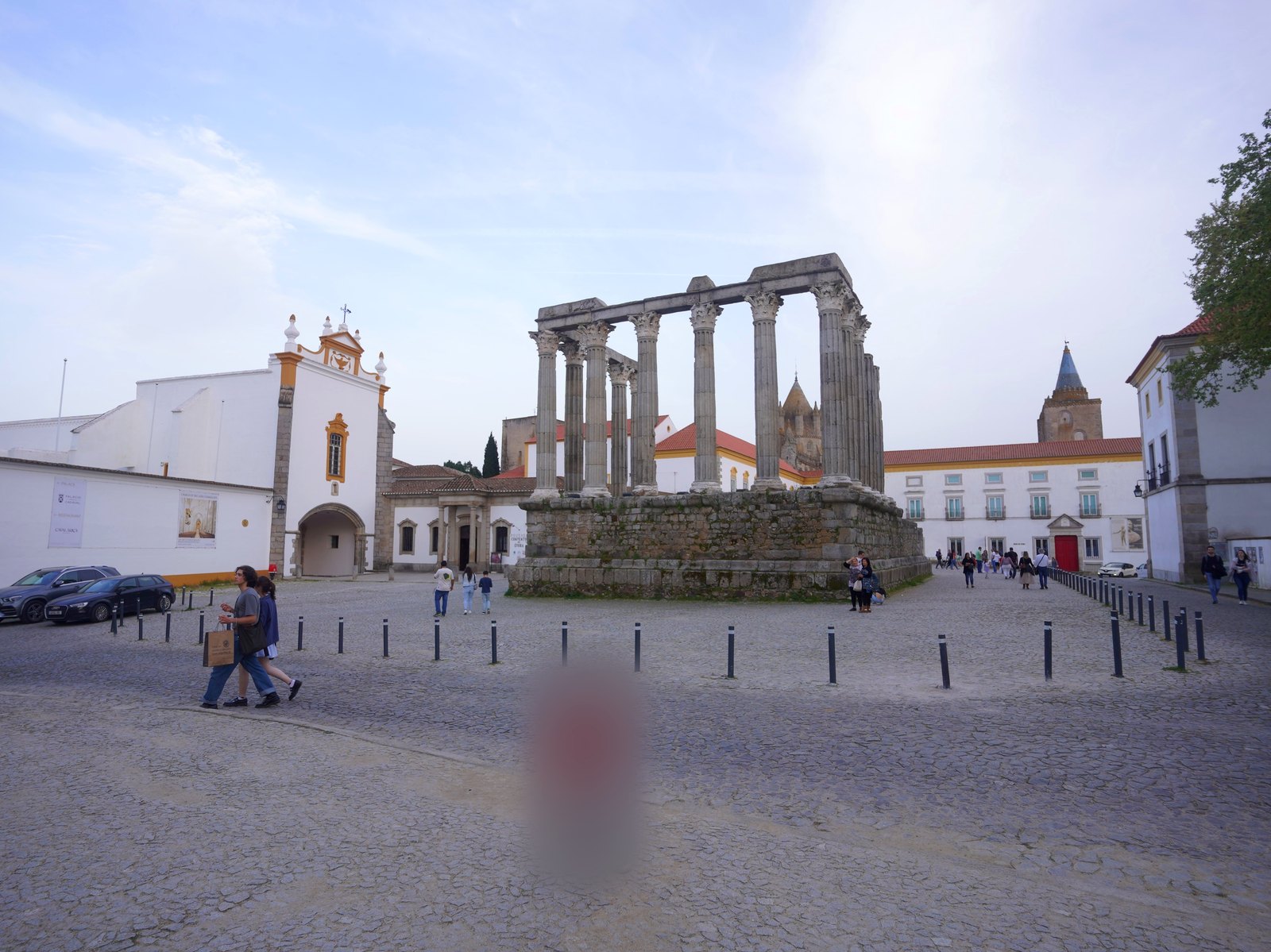
In the park behind the temple we looked at a monument and a small fountain and took in the view over town before moving on. In the narrow lanes we kept passing University of Évora students in black capes.
Playing in the water at the Portas de Moura fountain
Around 6:20 p.m. we reached Largo das Portas de Moura, a square with the Portas de Moura fountain (Fonte das Portas de Moura) in the middle. Built in 1556, it has a stone sphere perched on top of the basin. Just dipping a hand in the fountain was enough to make our kid lose track of time. All around the square, white houses trimmed in yellow lined every lane.


Dinner at WOK KING, an Asian buffet outside Évora
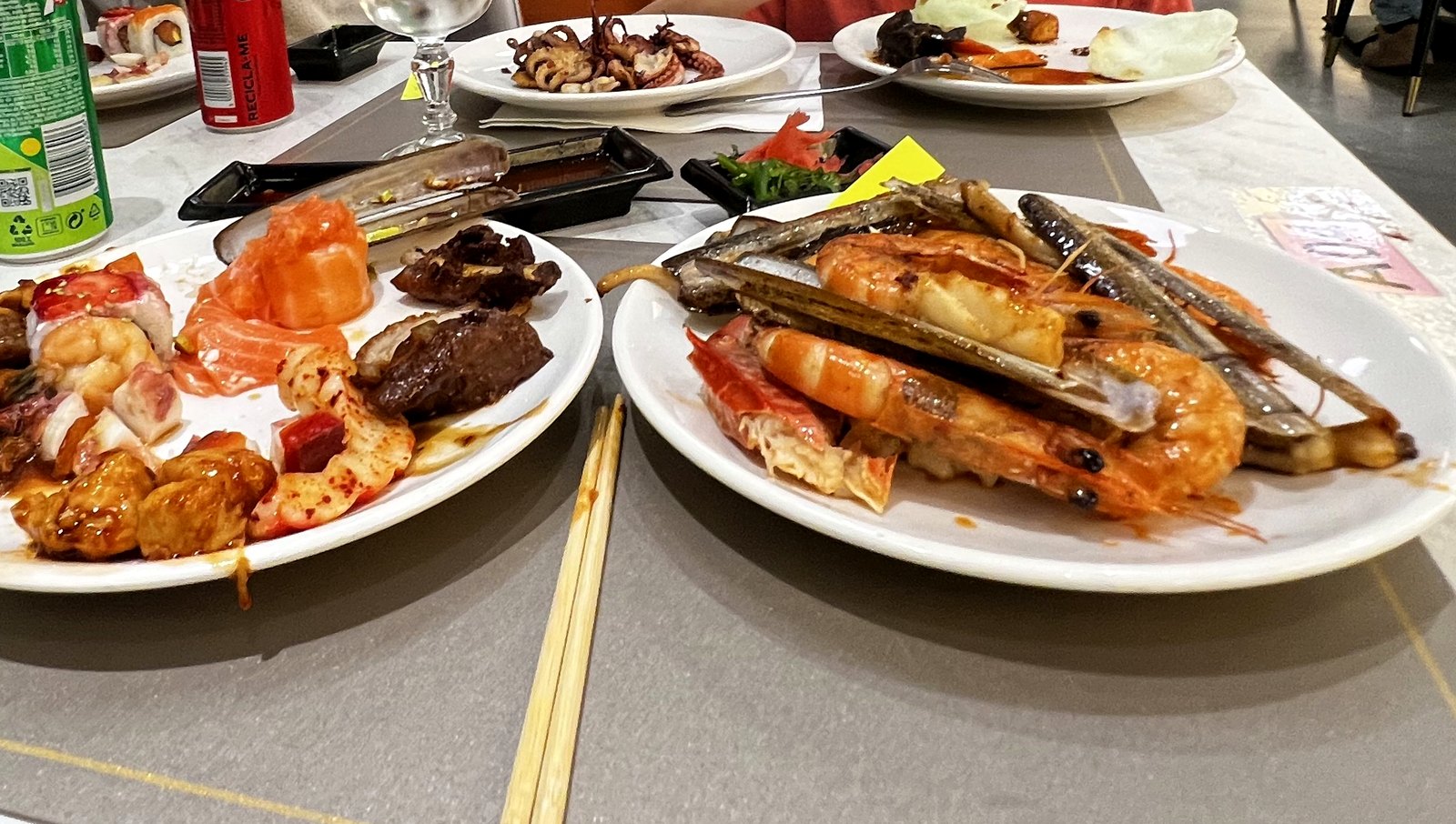
We’d eaten a lot of Portuguese food on the way from Lisbon to Albufeira, so for a change, around 7:10 p.m. we drove to WOK KING, an Asian buffet on the edge of Évora. We went in with low expectations, the way you do at an all-you-can-eat buffet, and the food turned out to be fresh and good. There was a griddle station and plenty of seafood dishes: shrimp, razor clams, octopus. All three of us left happy, and we liked it so much that the next day in Coimbra we went looking for another buffet.
Everything we ate and shopped for in Portugal is in Portuguese food: what we ate in two weeks.
Our B&B in Vendas Novas
It was a Saturday and it was getting late, so finding a room in Évora itself wasn’t easy. We’d left this one night open in our plans, and since we only needed a place to sleep, the next day’s route came first. That led us to MIX inn, a B&B in the small town of Vendas Novas, about 57 km (35 mi) west of Évora on the way to Óbidos. We booked it after dinner and drove over.
We pulled into the quiet town very late, slept, had breakfast and left. Even though we arrived so late, the owner welcomed us without any fuss, and the layout inside was unusual. The next morning an older woman showed us to breakfast with a gentle smile. It was a short stay, but it felt very much like a real neighborhood place.
Still, driving away from Évora, I caught myself wondering what it would have been like to stay in Évora and take our time.
If you spend a night in Évora
Staying close to the old town means you can wander the lanes and squares after dark. We didn’t stay at any of these; distances are straight-line from Praça do Giraldo, the main square in the middle of the old town.
Good to know
Hours and prices
Chapel of Bones, Évora (Church of São Francisco)
- Summer time (DST)9 a.m.–6:30 p.m.
- Winter9 a.m.–5 p.m.
- ClosedJanuary 1Easter SundayDecember 24 (afternoon)December 25
- Adults€7
- Under 25€5 also €5 for 65 and over
- Family€15 two adults and a teenager
- Main churchFree
Street parking in Évora’s old town
- WeekdaysPaid 8:30 a.m.–7:30 p.m.
- SaturdayPaid 9 a.m.–2 p.m.
- Visitors4 hours max at a time
- OtherwiseFree on Sundays, holidays and outside paid hours
Évora tourist tax
- Rate€1.50 per night
- SinceAugust 1, 2025
Chapel of Bones and Évora parking details checked against the official sources in October 2026. The tourist tax is based on press reports from August 2025, so double-check with your hotel before you stay.
GlossaryWords worth knowing before you go
- Chapel of Bones Capela dos Ossos
- Portuguese for “chapel of bones”In English it’s usually just called the Chapel of Bones.
- Cork oak Sobreiro
- The cork treeA species of oak whose bark is stripped to make cork
- Cork-oak pasture Montado
- Cork-oak woodland mixed with grassland and fieldsYou’ll see it all over the Alentejo plain.
- River beach Praia fluvial
- A swimming spot set up on a river or streamPraia means beach.
- Nativity scene Presépio
- A model of the stable where Jesus was born, with small figures
Quick Q&A
How much is the Chapel of Bones in Évora, and when is it open?
According to the Church of São Francisco’s official site, tickets are €7 for adults, €5 for anyone under 25 or 65 and over, and €15 for a family (two adults and a teenager). It’s open 9 a.m. to 6:30 p.m. during summer time and 9 a.m. to 5 p.m. in winter. The same ticket covers the museum upstairs, the nativity collection and the terrace.
Is the Chapel of Bones OK for kids?
A room covered entirely in human bones can be a shock at first. Our kid was tense but kept thinking about the inscription and the poem long afterward, and enjoyed the tiny nativity scenes in the museum upstairs. It helps to explain what the place is before you go in. The official price list has no separate child fare, just €5 for under-25s and the €15 family ticket.
Does Alte waterfall always have water?
Apparently not: after a stretch without rain, some visitors find little more than a dry cliff. When we went in late March, there was plenty of water in both the fall and the pool. If you’re going in the dry season, keep your expectations modest.
How long is the drive from the Algarve to Évora?
From Albufeira to Évora via Alte waterfall is about 225 km (140 mi), roughly 2 hours 40 minutes of driving on Google Maps in typical traffic. We left the resort around 11:45 a.m., stopped in Alte, and reached Évora around 4:20 p.m. With the drive on to our B&B in Vendas Novas, the day came to about 280 km (174 mi).
Where do you park in Évora?
We left the car in a big parking area outside the walls and walked in. Street parking inside the old town is paid on weekdays during the day and on Saturday mornings into the early afternoon, and visitors can park for up to four hours. The Chapel of Bones, the Roman temple, the cathedral and the Portas de Moura fountain are all within walking distance, so parking outside the walls was no trouble.
The day in brief
- Time spentAlte waterfall and village: about an hourÉvora old town: about two and a half hoursBuffet dinner: a little over an hour
- Getting aroundRental carAbout 280 km (174 mi), roughly 3 hr 25 min of driving
- AdmissionOnly the Chapel of Bones charges (€7 adults)Everything else needs no ticket
- Best forAnyone driving north from the AlgarveFamilies who want a waterfall and an old walled town after a few beach daysAnyone who wants to walk through places with a story, like the Chapel of Bones and the Roman temple, with their kids
- Next timeWe’d spend a night in Évora and take it slowly.We’d linger at the bakeries and restaurants that looked so good.
Évora had an atmosphere all its own, the kind you rarely find in other European towns, and the Chapel of Bones is what fixed it in our memory. The inscription over the door, our kid calling the gaps in the walls spots kept open for us, the story of the mummies: the three of us were caught up in all of it that afternoon, and that’s why Évora stayed with us so vividly. Next time, I’d like to sit a little longer in those bakeries and restaurants.
Related posts
Where everything is
Every stop, grouped by town or village. Numbers match the route map above.
| Place | When and what we did | Map |
|---|---|---|
| March 23 · Albufeira → Vendas Novas | ||
| 1AlbufeiraAlgarve coast | Left the resort around 11:45 a.m. | Start |
| 2AlteMunicipality of Loulé | About an hour from around 12:35 p.m. | Village |
| Alte waterfall | A long rest by the pool below the falls | Map |
| Village river beach | Around 1:30 p.m., seen from above only | Map |
| 3ÉvoraAlentejo | About two and a half hours on foot from around 4:20 p.m. | Old town |
| Chapel of Bones | Around 4:20 p.m., plus the museum upstairs | Map |
| 🍽Aqui Há Pão | Around 5:20 p.m., pastries and coffee | Map |
| Cathedral | Around 5:40 p.m., outside only | Map |
| Roman temple | Right next to the cathedral | Map |
| Portas de Moura fountain | Around 6:20 p.m., splashing in the fountain | Map |
| 🍽WOK KINGOutskirts of Évora | Around 7:10 p.m., Asian buffet dinner | Map |
| 4Vendas NovasBetween Évora and Lisbon | Arrived at night, one night | Town |
| 🛏MIX inn | B&B, breakfast the next morning | Map |
The map links search by name, so double-check the location before you go.
Planning a trip to Portugal?
We flew into Lisbon and out of Porto, and covered the Algarve and Évora in a car rented in Lisbon. You can compare flights and rental cars here.
Sources 13 links
- Church of São Francisco, official site: hours and prices Summer and winter hours, closing days, prices, and what one ticket covers (checked October 2026)
- Church of São Francisco, official site: the Chapel of Bones 17th-century construction, thousands of bones, ceiling frescoes from 1810 (checked October 2026)
- idealista, on the Chapel of Bones in Évora Estimate of more than 5,000 skeletons, the inscription over the door (September 2024)
- RTP, research on the chapel’s mummies University of Évora researchers: an adult woman and a girl (December 2019)
- Visit Loulé (Loulé tourism), Alte waterfall Parking by the cemetery, wooden steps or a dirt path of about 300 m, 24 m drop (checked October 2026)
- Postal do Algarve, Alte’s springs and waterfall Summer swimming (July 2024)
- UNESCO World Heritage Centre, Historic Centre of Évora Inscribed in 1986
- Visit Portugal, Évora Cathedral Largest medieval cathedral in Portugal, begun 1186, completed 1250
- Wikipedia, Roman Temple of Évora 1st-century construction, origin of the “Diana” name, a butcher’s shop until 1836, restored in the late 19th century
- City of Évora, water heritage leaflet Portas de Moura fountain, 1556
- City of Évora, amended old-town parking regulations Paid hours, 4-hour maximum for visitors (October 2024)
- Julie Dawn Fox, Portuguese cork First harvest at 25 years, nine-year cycle, numbers on the trunks, more than half of world production
- Observador, Évora tourist tax (August 2025)
Not in the list? Search it yourself
Affiliate link: if you book through this search, the blog earns a commission at no extra cost to you. Results open in a new tab. Details
Discover more from Elsewhere, Mostly
Subscribe and get new posts sent straight to your inbox.