This post contains affiliate links. If you book or buy through them, I earn a commission at no extra cost to you. As an Amazon Associate I earn from qualifying purchases.
In this post: our first four nights in Lisbon, at the start of two weeks in Portugal. Day one was Chiado and the Santa Justa Lift, day two ended with sunset at São Jorge Castle, and day four was a walk through the Age of Discovery in Belém. Everything is in date order, up to the morning of day five, when we picked up a rental car and left town.
March 17Sun · Day 1
- Land in Lisbon, prebooked airport pickup to our place in Chiado
- First snacks in Chiado
- Pink Street
- Basílica dos Mártires, nata and espresso
- Santa Justa Lift and the viewpoint at the top
- Seafood dinner in Chiado
March 18Mon · Day 2
- LX Factory, lunch nearby, a fruit stand
- SNBA gallery
- São Jorge Castle, sunset and the walls
- Praça da Figueira, sushi dinner
- Rua Augusta Arch, Praça do Comércio
March 19Tue · Day 3
- Day trip to Sintra, Cabo da Roca and Cascais in a separate post
March 20Wed · Day 4
- Store the bags, taxi to Belém
- Jerónimos Monastery
- Nata at Pastéis de Belém
- Late lunch at Adega de Belém
- National Coach Museum
- Belém Tower
- Marina, a try at hand-line fishing
- Monument to the Discoveries
- Taxi back downtown, small hotel in Baixa
March 21Thu · Day 5, morning
- Pick up a rental car downtown and head south
- WhenSunday, March 17 – Thursday morning, March 21, 2024 (days 1–5 of the trip)
- WeatherHighs of 25°C (77°F) on March 17, 24°C (75°F) on March 18 and 21°C (70°F) on March 20; no rain
- AdmissionPaid · São Jorge Castle, Jerónimos Monastery cloister, National Coach Museum, Belém Tower, the viewpoint on the Monument to the DiscoveriesFree · the streets of Chiado and Baixa, Praça do Comércio, the riverside promenadePrices are collected under “Good to know” below.
- Getting aroundOn the Lisboa Card · Santa Justa Lift (out of service since September 2025) · bus 737 up to the castle · Tram 28Taxis to and from Belém · a rental car from a downtown branch on the morning of March 21
- ReservationsWe prebooked an airport pickup.We paid for São Jorge Castle at the gate.
- WhoTwo adults, one kid
- Where we stayedA downtown apartment-style stay with self check-in, 3 nightsA small hotel in Baixa for the fourth night
In this post
We spent the first four nights of our two weeks in Portugal in Lisbon. Between landing on the afternoon of March 17 and picking up a rental car on the 21st to drive south, we walked the city and Belém for three days and spent one day out in Sintra, Cabo da Roca and Cascais. This post covers those 3 days in Lisbon (March 17, 18 and 20), in date order. The day trip to Sintra, Cabo da Roca and Cascais on the 19th has its own post, and this one ends on the morning of the 21st, as we drove out of town.
Sketch map of our three days in Lisbon · LX Factory and the SNBA gallery (day two) are off the map, and Sintra, Cabo da Roca and Cascais (day three) have their own post
Day one: Chiado and Baixa, wherever our feet took us
We landed in Lisbon around lunchtime, and a pickup we’d booked ahead drove us about 30 minutes to our place in Chiado. We hadn’t planned the first day at all, so we just walked. How we got in from the airport is below; the rest of the logistics, from the rental car to the Lisboa Card, are in our post on getting around Portugal.
The temperature numbers hadn’t told us much about what the day would feel like, but out on the street the sky was clear and it was a good day for walking. In shops and restaurants, people kept adding a warm word or two after we’d paid. That little extra became my first impression of Lisbon.
The first thing we ate in Portugal was a meat croquette, followed by some very good chicken and a sweet custard tart.
After a bit of shopping in Chiado, we walked down Pink Street (Rua Nova do Carvalho), its pavement painted pink. On a nearby side street, rows of colorful umbrellas hung overhead.
Over the next few days, whenever that pink street came into view, we knew we were close to our apartment. It turned into our landmark.

Nata, espresso and a church
As the sun got lower, we climbed Rua Garrett in Chiado and stepped into the Basílica de Nossa Senhora dos Mártires for a few minutes. Back outside, we ordered nata (pastel de nata, Portugal’s custard tart) and espresso at a shop nearby.
We ate a lot of nata on this trip. We’d stop at whatever shop we passed and buy one each, always with an espresso on the side. We never had a bad one, and our kid liked them so much that comparing shops became a small project. Everything we ate in Portugal, plus our supermarket runs, is in our Portuguese food post.


From the airport into the city
We had booked an airport pickup ahead of time. From arrivals to the door of our place in Chiado took about 30 minutes, and with a pile of luggage and a kid in tow, a car to the door made the first day easy. You can also take the metro, and if you have a Lisboa Card, it covers the metro too.
SIM cards
A chunk of our first afternoon went to buying SIM cards at a Vodafone store downtown. We bought two, one each for my wife and me, with enough data for two weeks.
The Santa Justa Lift on our first night
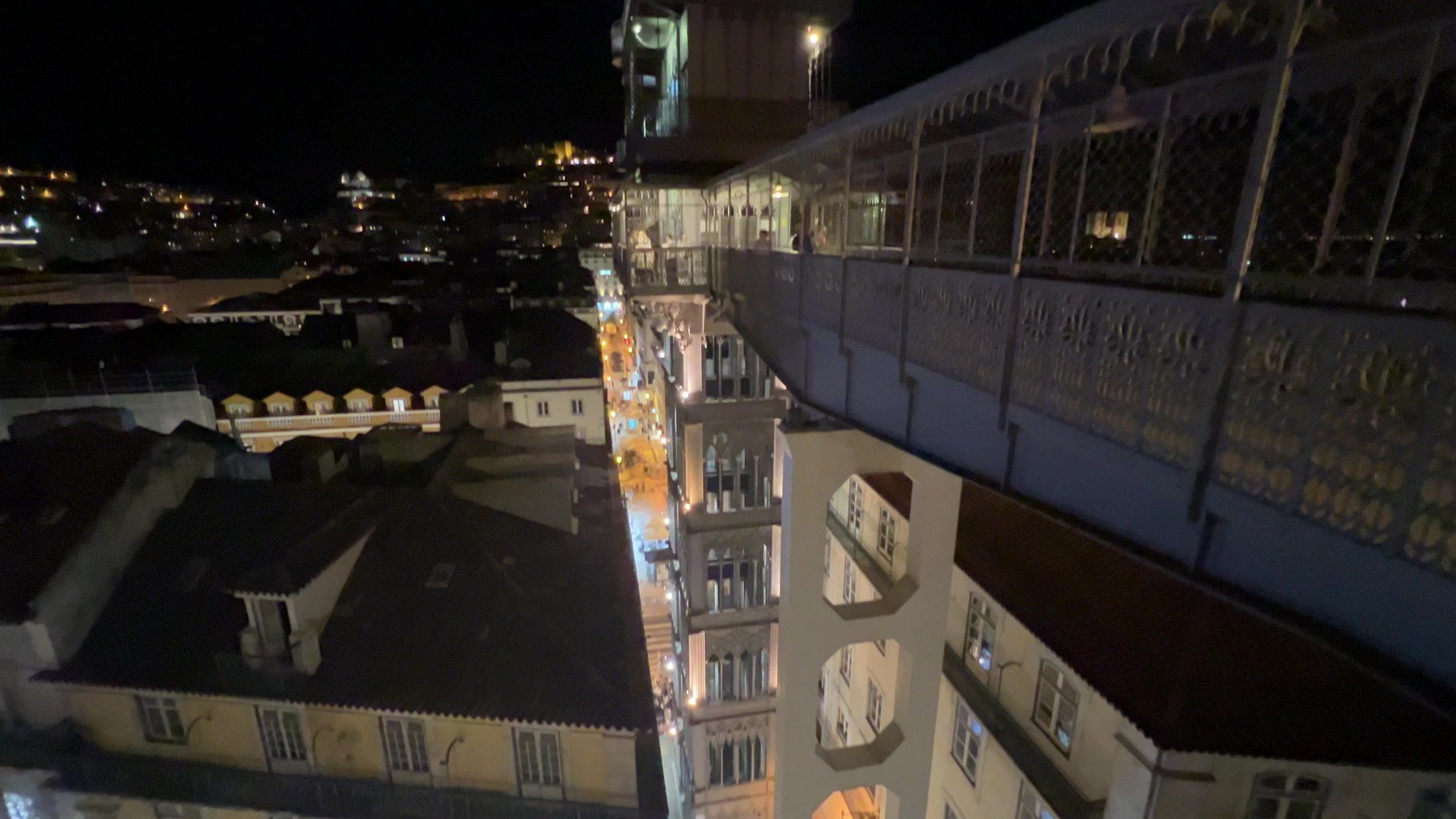
Around 7 p.m. we walked down into Baixa and stood in front of the Santa Justa Lift (Elevador de Santa Justa), the iron elevator that links Baixa with Largo do Carmo up the hill. It was built by Raoul Mesnier du Ponsard, known as a student of Eiffel, and, as I read it, it was part of the city’s public transportation when it opened in 1902. Note, though, that the lift has been out of service since September 2025, so you can’t ride it now (see “Closed for now” below).
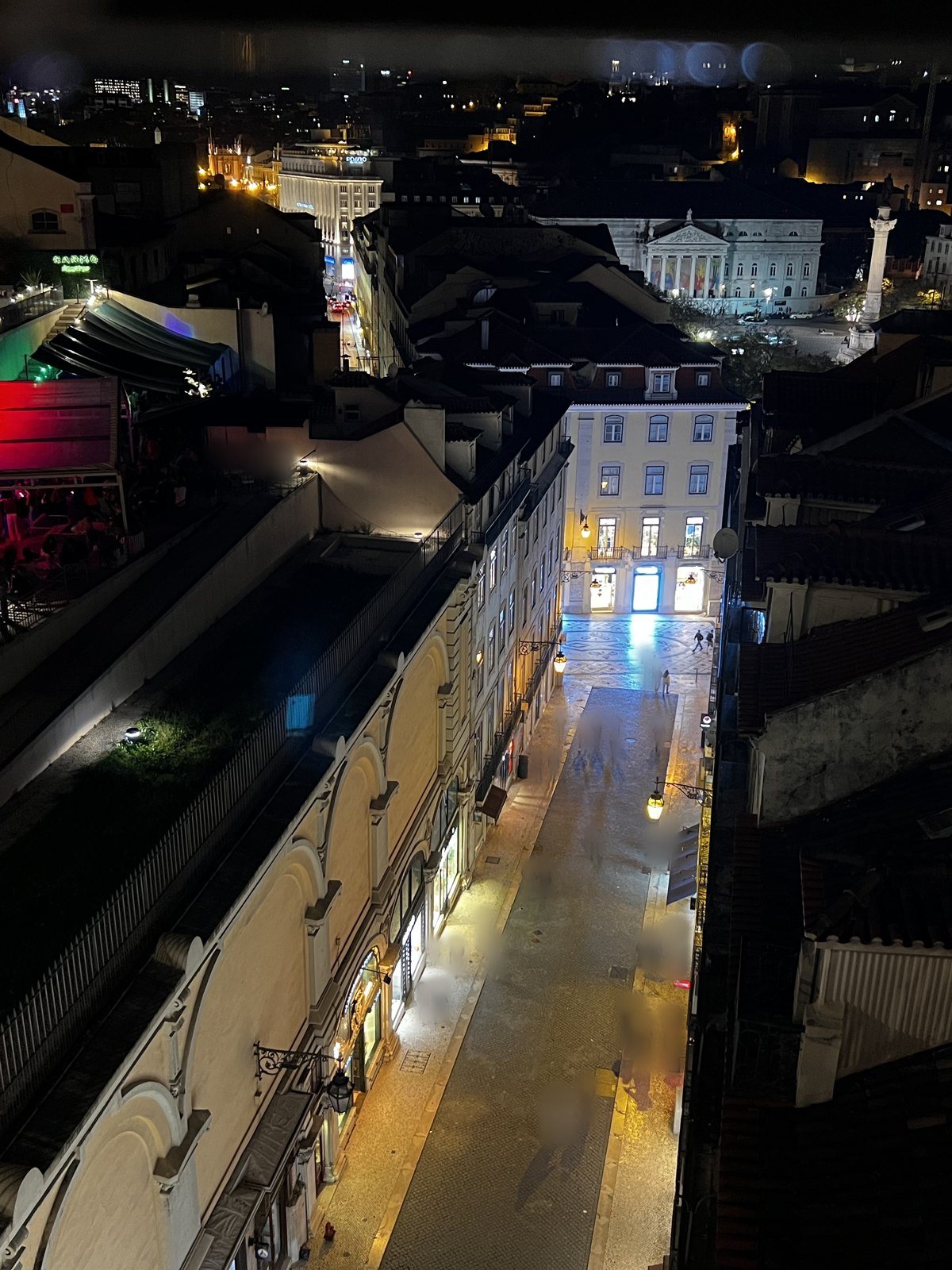
After dark, the ironwork lit up. You ride up in an old wood-paneled car, step out onto the viewing deck, and Baixa’s straight streets run out below you, with the lights of São Jorge Castle on the hill across the way. That was the castle we went to for sunset the next evening.
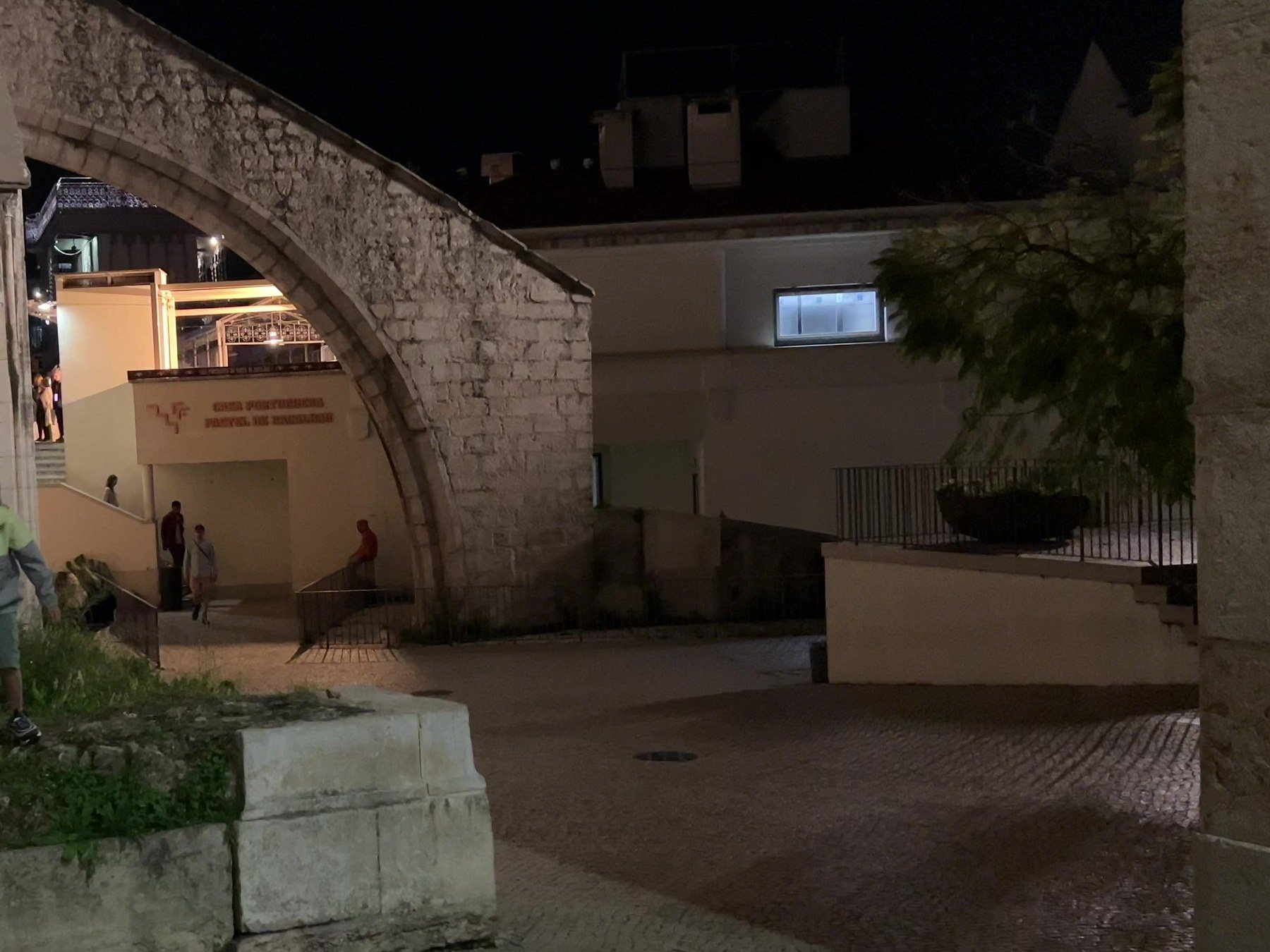
From the deck, a narrow spiral staircase climbs one more level to a spot that’s open on all sides. We stayed up there a long time looking over the city, then left through the upper exit and walked toward Largo do Carmo.


How to get there
The lower entrance, on the Baixa side, is on Rua de Santa Justa. If you walk over from Chiado or Largo do Carmo, the upper exit takes you straight onto the viewing deck.
Closed for now
- The lift stopped running in September 2025. A press report said it should reopen in January 2027, but the operator, Carris, has not confirmed a date. When I checked Carris’s official website in October 2026, the viewing deck at the top was also listed as temporarily closed. If you plan to go, check Carris’s notices first.
- When it runs, it’s a Carris line, so the Lisboa Card covers it. The viewing deck at the top isn’t included in the card and is listed as a separate charge (Visit Lisboa, checked October 2026).
- For a similar view, try the Miradouro de São Pedro de Alcântara above Chiado, which looks out over Baixa and the castle together. The Glória funicular (Ascensor da Glória) that used to run up to it has been stopped since an accident in September 2025, so for now you walk up.
How long we spent
In March 2024 the line was long. We joined it at the lower entrance around 7:05 p.m. and didn’t get into a car until close to 8, so nearly 50 minutes of waiting. We rode on the Lisboa Card. Counting the line, it was about 1 hour 15 minutes from reaching the entrance to leaving the deck.
Good to know
- Dusk into evening was the best time. You get Baixa’s lit-up streets and São Jorge Castle in one view.
- The spiral staircase above the viewing deck is narrow. Hold your kid’s hand on the way up.
- The upper exit connects to Largo do Carmo, which makes it easy to walk back toward Chiado afterward.
Seafood dinner in Chiado
Dinner was at Sacramento do Chiado, a seafood restaurant in Chiado. The arroz de marisco, Portugal’s seafood rice, came loose and brothy, closer to a seafood stew with rice in it than a dry rice dish. We also had clams cooked with garlic and cilantro.

Our kid named this seafood dinner the best part of the day.
Our server was lovely. Every time she took an order or brought a dish, she added a kind word or two, and with our kid she made eye contact and was warmer still. That habit of adding a word or two of kindness was one of the things I liked most about Portugal.
Day two: LX Factory and the SNBA gallery
Lisbon’s national museums and monuments close on Mondays, so on day two we picked places that were open and took it slow. We started late morning with nata and coffee at a café.
LX Factory is an old factory complex filled with small shops and restaurants. For lunch we went to O Escorpião, a local restaurant nearby, and had cod and duck. The wine that came with it was so generous for the price that we double-checked we’d ordered what we thought we had.
The Alcântara area around LX Factory draws visitors, but it still felt like a local neighborhood, with an old tram depot and rows of colorful old houses. The morning had been cloudy; by lunchtime the sky had cleared.
Near the restaurant was a small neighborhood fruit stand with potted plants and crates of fruit out on the sidewalk. I still remember the midday sun falling on the halved watermelons and papayas on display. We bought strawberries and mandarins there, and our kid was thrilled to be eating strawberries the size of a fist.
In the afternoon we stopped by the SNBA gallery (Sociedade Nacional de Belas Artes), which was open. An exhibition was on for the 50th anniversary of the Carnation Revolution of April 25, 1974 (50 Anos de Abril na SNBA). We looked around briefly, then took a break with pastries and drinks at a bakery nearby.


Sunset over the Tagus from São Jorge Castle
Late in the afternoon we went to São Jorge Castle (Castelo de São Jorge), the one we’d been looking at from the top of the Santa Justa Lift the night before. We rode a bus up the fairly steep hill on the Lisboa Card and got off right at the castle entrance. At the time the castle wasn’t included in the Lisboa Card, so we paid for admission at the gate.
There were a lot of peacocks in and around the castle. That day we learned, for the first time, that peacocks climb tall trees and rest up on the branches. Their call was so loud and shrill that tourists all over the place, our kid included, kept trying to imitate it.

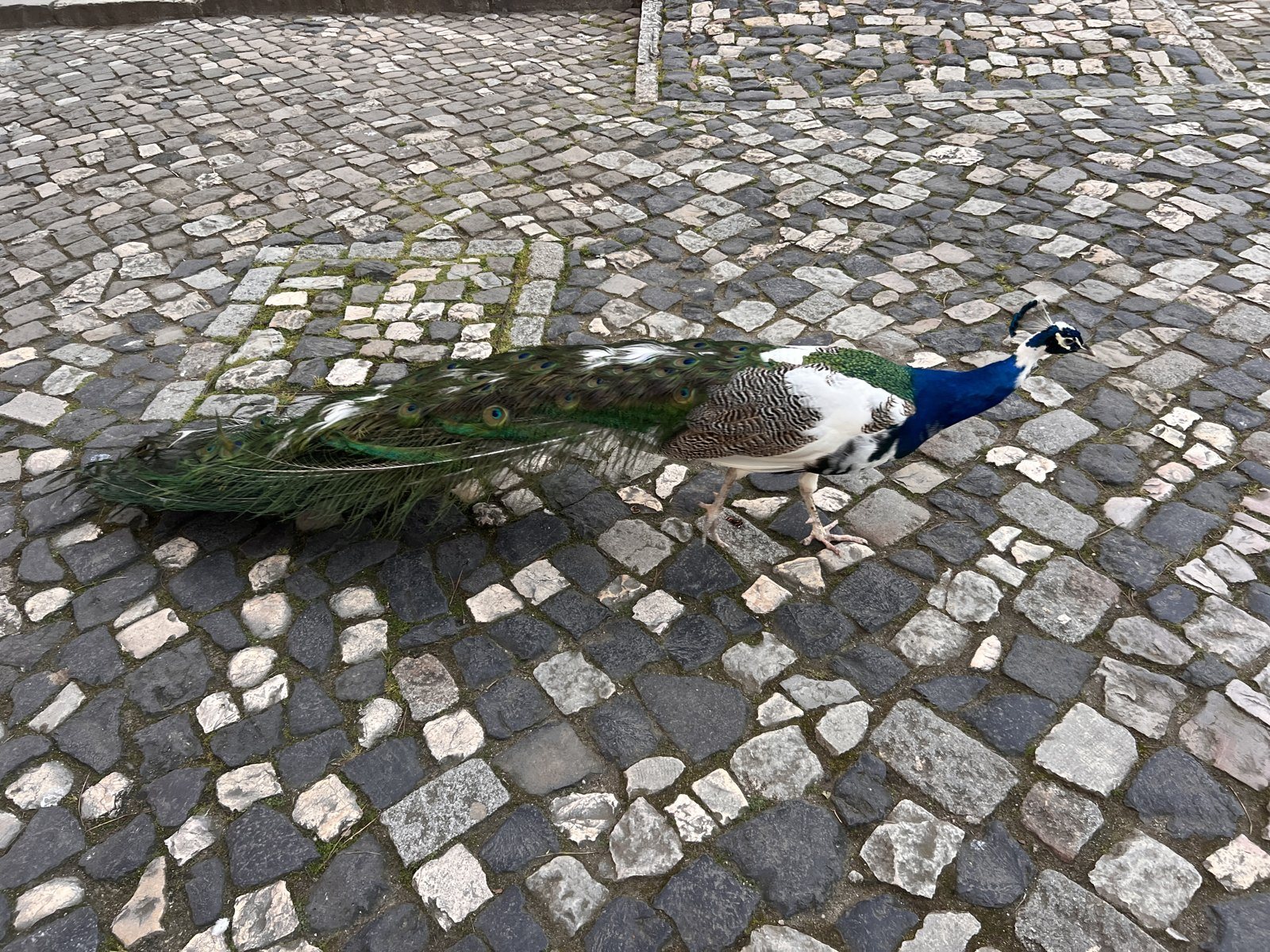
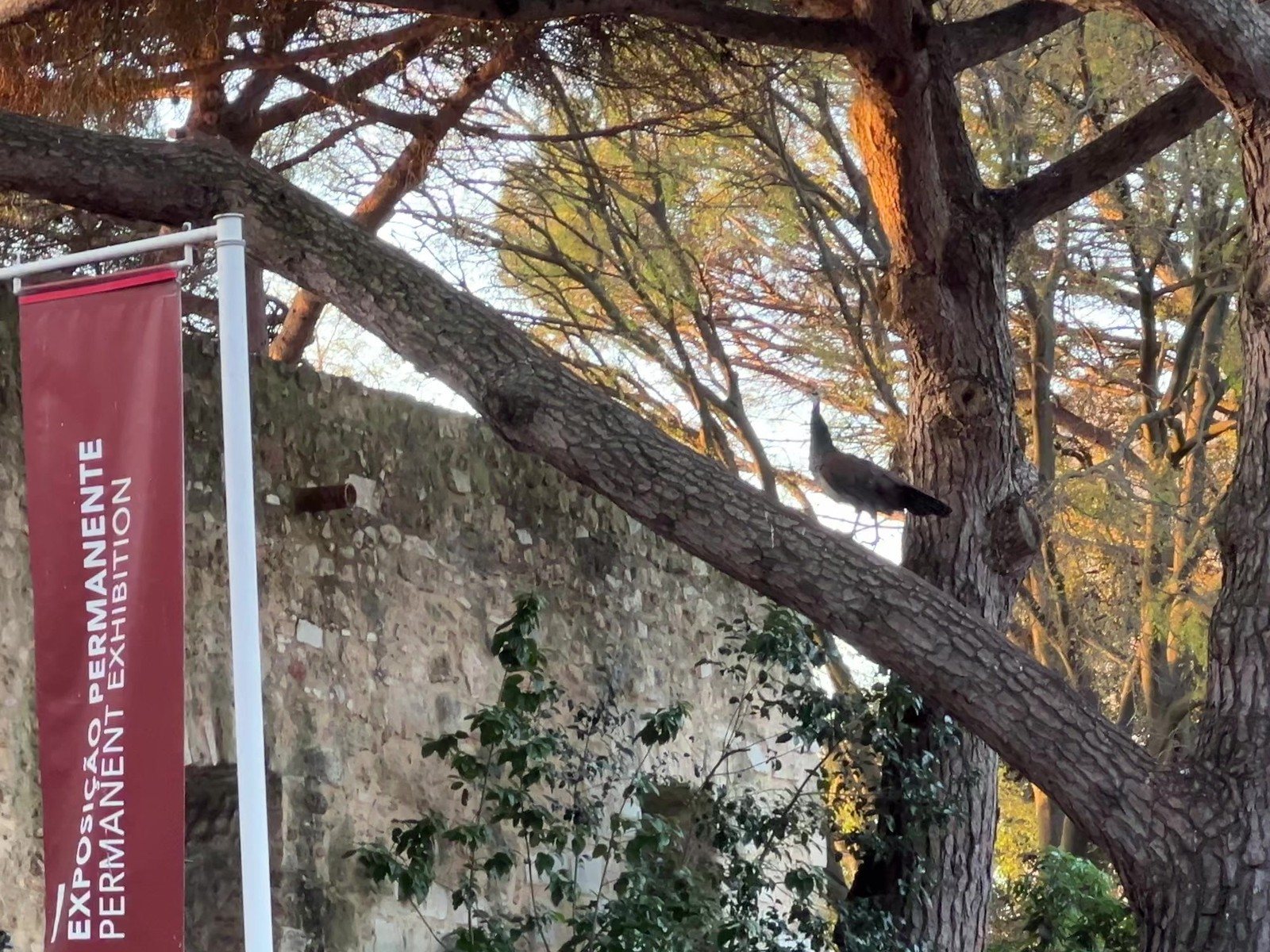
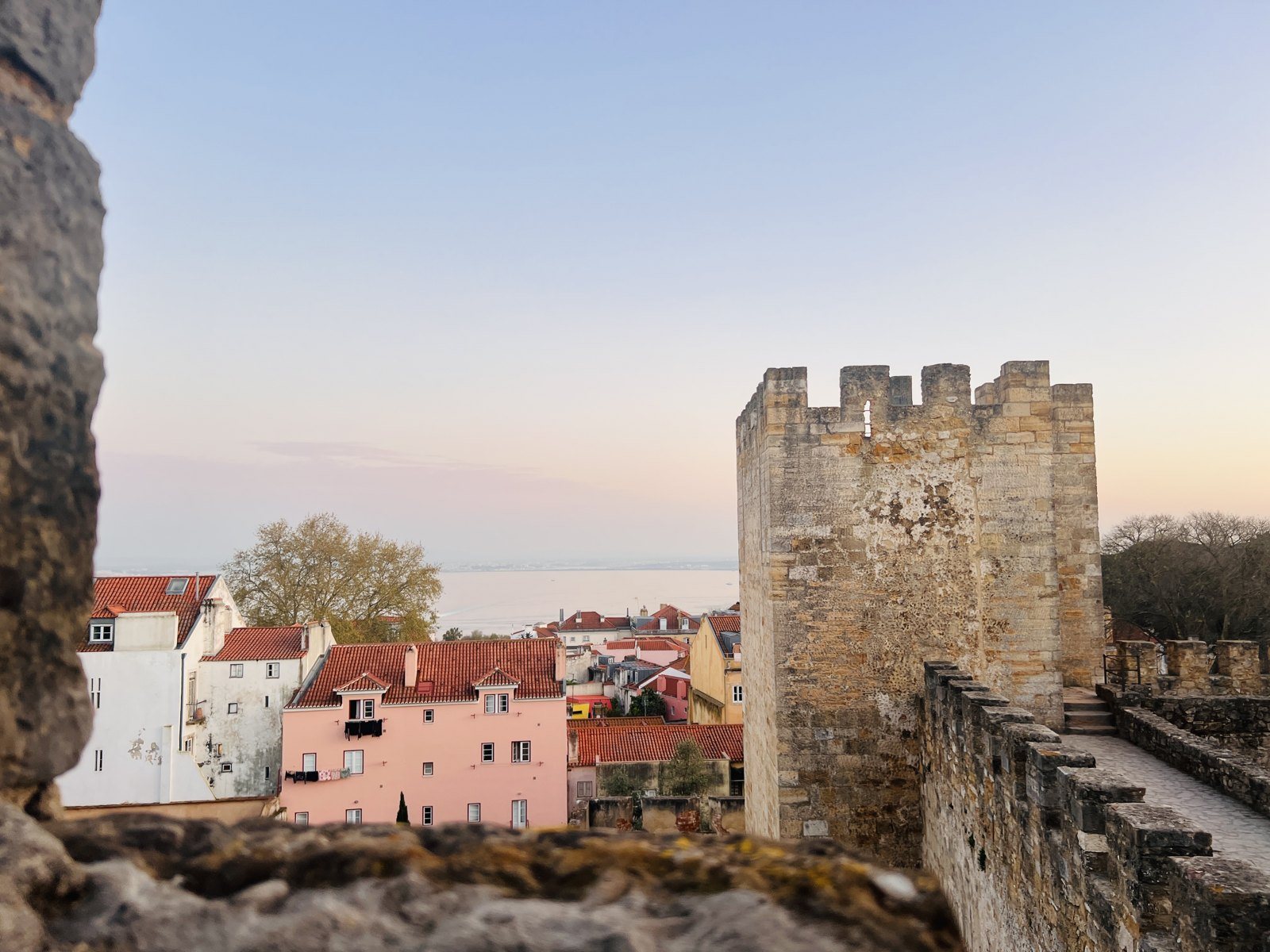
We’d heard the walls and towers close shortly after sunset, so we hurried up onto the walls while it was still light. Set into the walls were gun ports, openings for pointing cannon or guns at attackers.
The sun went down over the Tagus (Tejo) around 6:40 p.m. Beyond the walls, the city and the river turned red.

As the sun sank, I heard myself say, “Wow, that’s beautiful.” Orange light spread over the orange roofs, the red of the sunset settled in, and the place took on a mood all its own. The whole city was laid out below the castle, and our kid spent a long time searching the rooftops for our apartment.


Walking along the walls, we talked for a long time as if we’d gone back to those days. The first walls on this hill went up around the 10th century, when Muslim rulers held the Iberian Peninsula. In 1147, Afonso Henriques, Portugal’s first king, took the castle after a siege of nearly four months, with northern European knights who had stopped in Lisbon on their way to the Second Crusade. In the 14th century, armies from the neighboring kingdom of Castile invaded, and the castle and city held out more than once, in 1373 and again in 1383–1384.
When I told our kid about the gun ports we’d seen, our kid started laying out battle plans, one after another: where to stand and how to stop the enemy coming up the hill. The ideas kept coming for more than two hours and picked up again the next day.
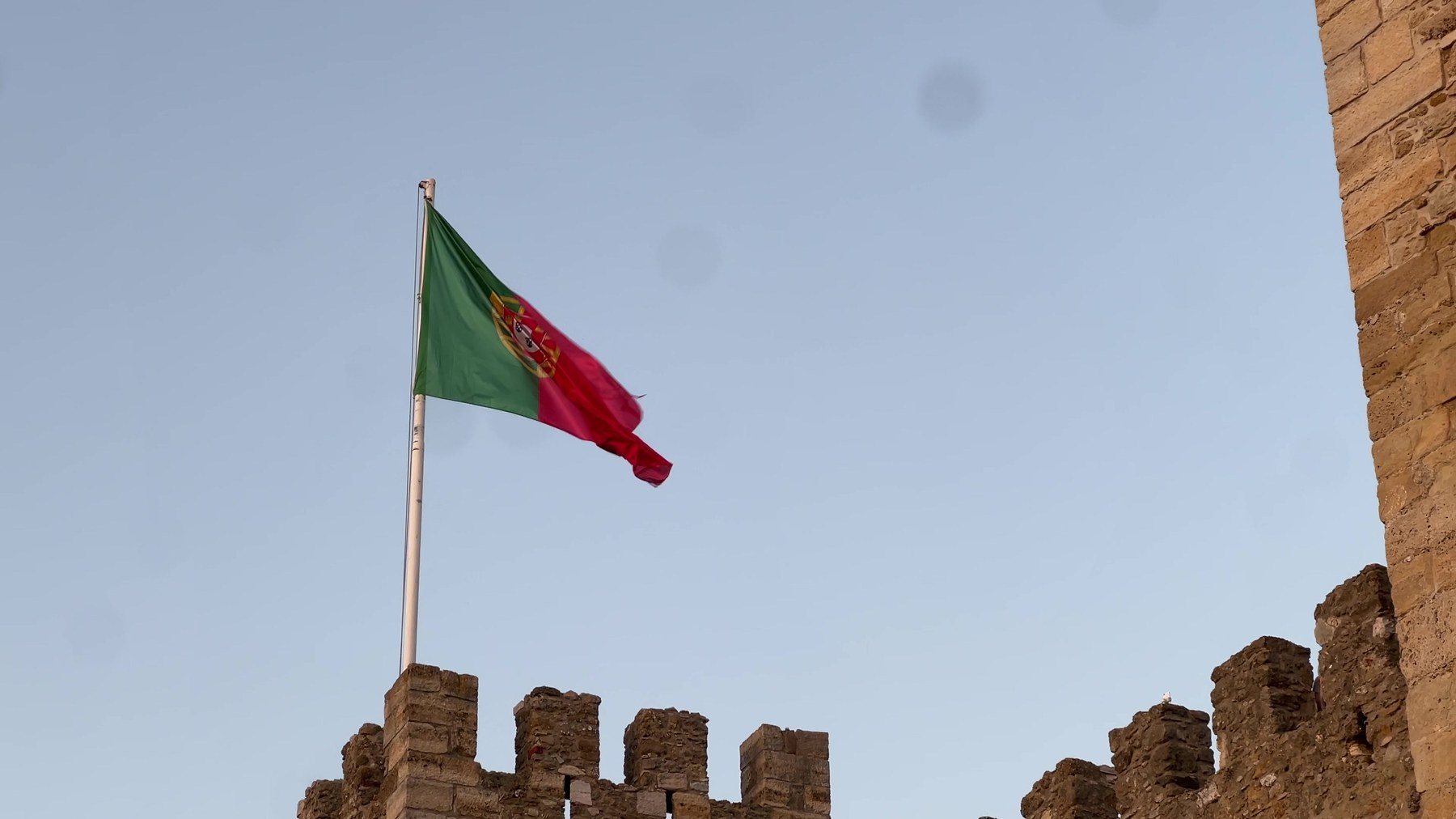
As the castle went dark behind us, we bought ice cream at a shop.

How to get there
The climb from Baixa to the castle is steep, so we took the bus both ways on the Lisboa Card. On the way up we caught it at the Sé (cathedral) stop: bus 737, with “737 CASTELO” on the windshield. The 737 starts at Praça da Figueira, passes the cathedral and goes right up below the castle. If you’d rather walk, the castle’s official website suggests using the public elevators in Baixa, Castelo and Chão do Loureiro, to cut out some of the climb (checked October 2026).
How long we spent
About 1 hour 10 minutes, from walking through the gate to buying ice cream and heading down. To see both the sunset and the walls, aim to arrive 30 minutes to an hour before sunset.
Good to know
- From March to October the castle is open until 9 p.m., but the walls and towers can close earlier, between 6 and 9 p.m. depending on sunset. If you wait until after the sunset to climb the walls, you may be too late.
- There are lots of peacocks in and around the castle. Look up for the ones perched in the trees.
Praça da Figueira and a sushi dinner
Coming down from the castle, we reached Praça da Figueira. A statue of a king on horseback stands in the middle, and at night the square was wide and empty. We took a quick look inside the nearby Igreja de São Nicolau, then went for dinner.
Lisbon has no shortage of restaurants, but our kid really wanted sushi that night. We’d spotted KIKU Sushi on the way up to the castle, so we went there. The sushi was good, and everyone left happy.


Through the Rua Augusta Arch to Praça do Comércio
After dinner we followed Baixa’s main street and walked through the Rua Augusta Arch (Arco da Rua Augusta). It was built as part of the rebuilding of the city after the 1755 Lisbon earthquake and finished in 1875.
On the other side of the arch, Praça do Comércio opens up along the Tagus. It’s a big, open square, and our kid’s step got lighter. Our kid loved wide squares like this one: no cars, not crowded even at night, plenty of room to run.
A young man in the square was selling propeller toys that you launch with a rubber band and that spin back down glowing with LED light. We saw him shooting them up to show how they worked and bought one. It cost a bit more than it would elsewhere, this being a tourist spot, but he was very friendly about it. Our kid got the hang of it fast and launched it, ran to catch it, and did it again, over and over. We took a short look at the Cais das Colunas on the river, then went back to the square and ended the day launching the propeller.

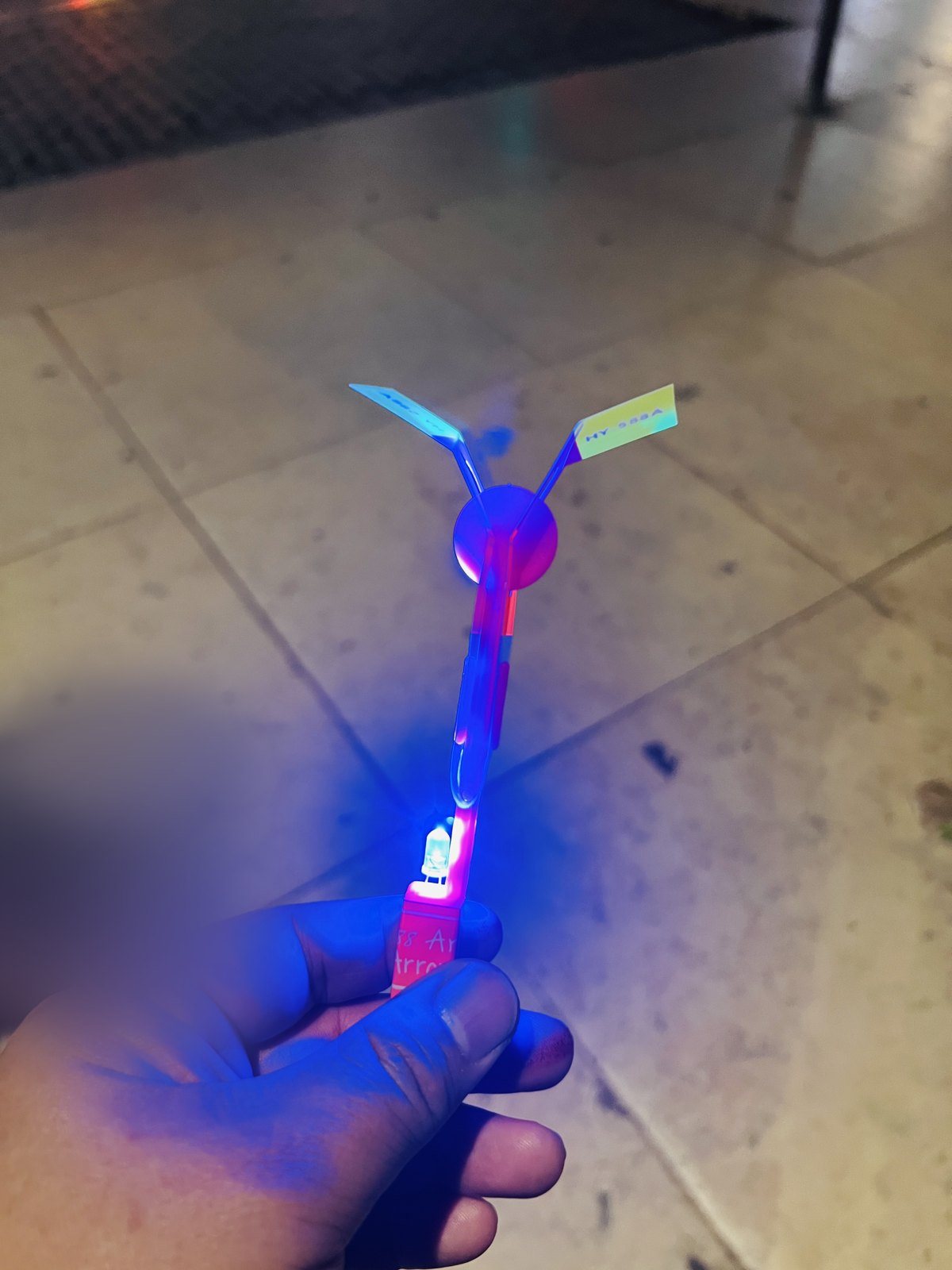
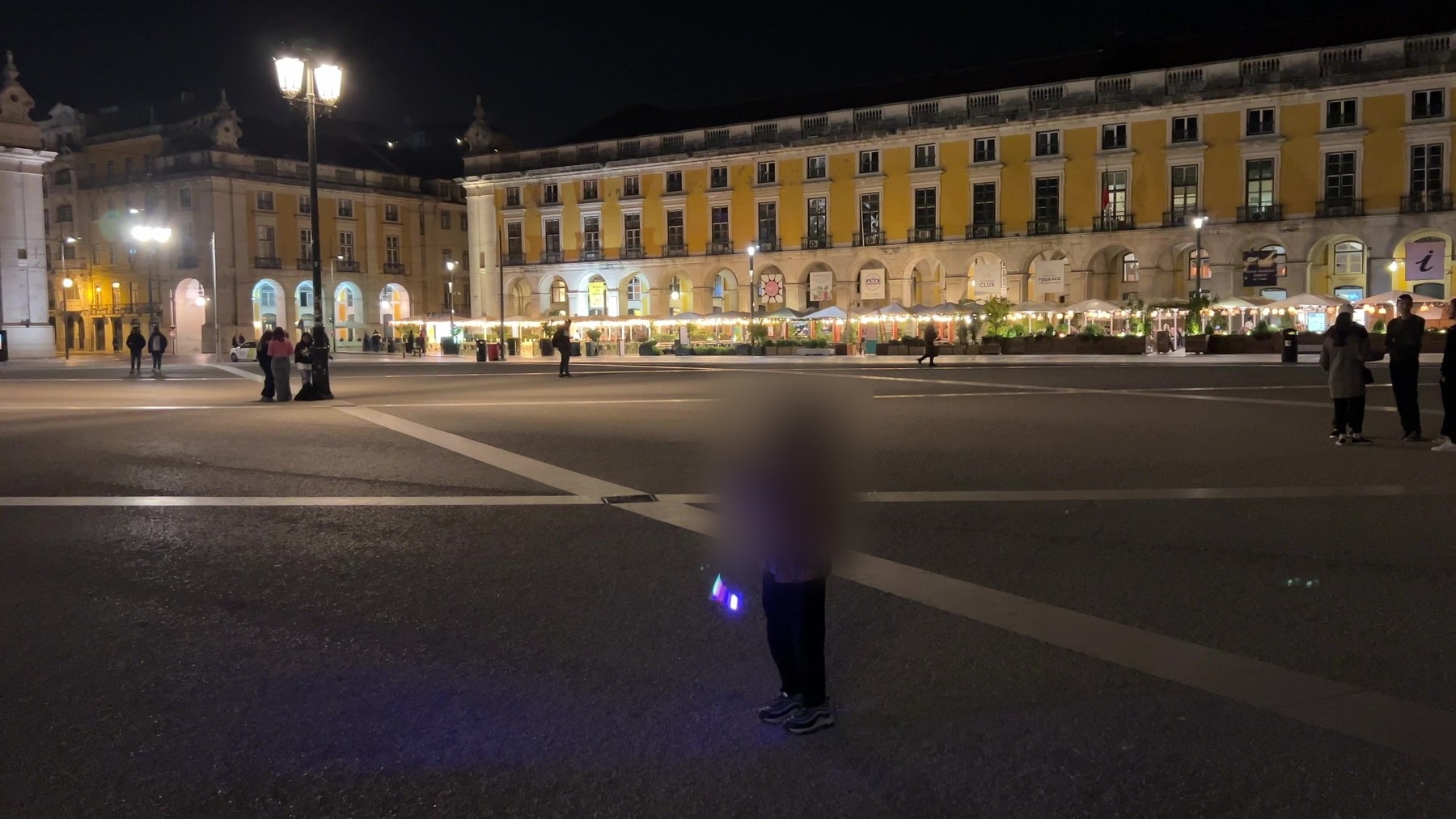
That glowing toy from Praça do Comércio
You launch it with a rubber band and it spins back down lit up, so kids can shoot it up and run to catch it. This is not the exact one we bought in the square.
March 19 On day three we left the city and did Sintra, Cabo da Roca and Cascais in one day. That day has its own post.
Day four: from downtown to Belém
On March 20, our fourth day in Lisbon, we went to Belém, which we’d saved for its own day. Belém is a neighborhood west of downtown along the Tagus (Tejo), and the traces of Portugal’s Age of Discovery are gathered there in one place. We saw Vasco da Gama’s tomb at Jerónimos Monastery, ate nata at the shop known as the original, and went on to the Coach Museum and Belém Tower before walking along the river to the Monument to the Discoveries as the sun got low.
When I list what I loved about Portugal, the Age of Discovery and Vasco da Gama always make the list. Belém is where most of those traces are.
This was also checkout day at our downtown apartment. It was self check-in, so there was no one to hold our bags, and we used a luggage storage app to leave them somewhere nearby. The taxi driver carrying our bags took a small detour along the river to show us the view. The waterfront promenade and squares in the sunshine, and the houses packed onto the hillside, slid past the window.
After finishing our morning plans, we took a taxi to Belém and were dropped in front of Jerónimos Monastery around 12:45 p.m.

How to get there
Tram 15E runs from downtown to Belém. It starts at Praça da Figueira, passes Cais do Sodré, and in Belém stops at “Mosteiro Jerónimos” and “Belém” (for the Coach Museum) (Carris official website, checked October 2026). With a Lisboa Card, city trams are covered.
We took a Bolt (a ride-hailing app like Uber) both ways.
Good to know
Jerónimos Monastery, the National Coach Museum and Belém Tower are closed on Mondays. The Monument to the Discoveries and Pastéis de Belém are open on Mondays. It’s best to plan Belém for another day of the week.
Jerónimos Monastery, where Vasco da Gama lies
Our first stop in Belém was Jerónimos Monastery (Mosteiro dos Jerónimos). It was built under King Manuel I to honor Vasco da Gama’s successful voyage, and it reportedly took about a hundred years to finish. The Manueline decoration, full of sea and seafaring motifs, is ornate and grand. Along with Belém Tower, it’s a UNESCO World Heritage Site.
We went into the church first. Inside are the tombs of Vasco da Gama and the Portuguese poet Luís de Camões. Standing where two people I’d only known as names are buried gave me a strange feeling.

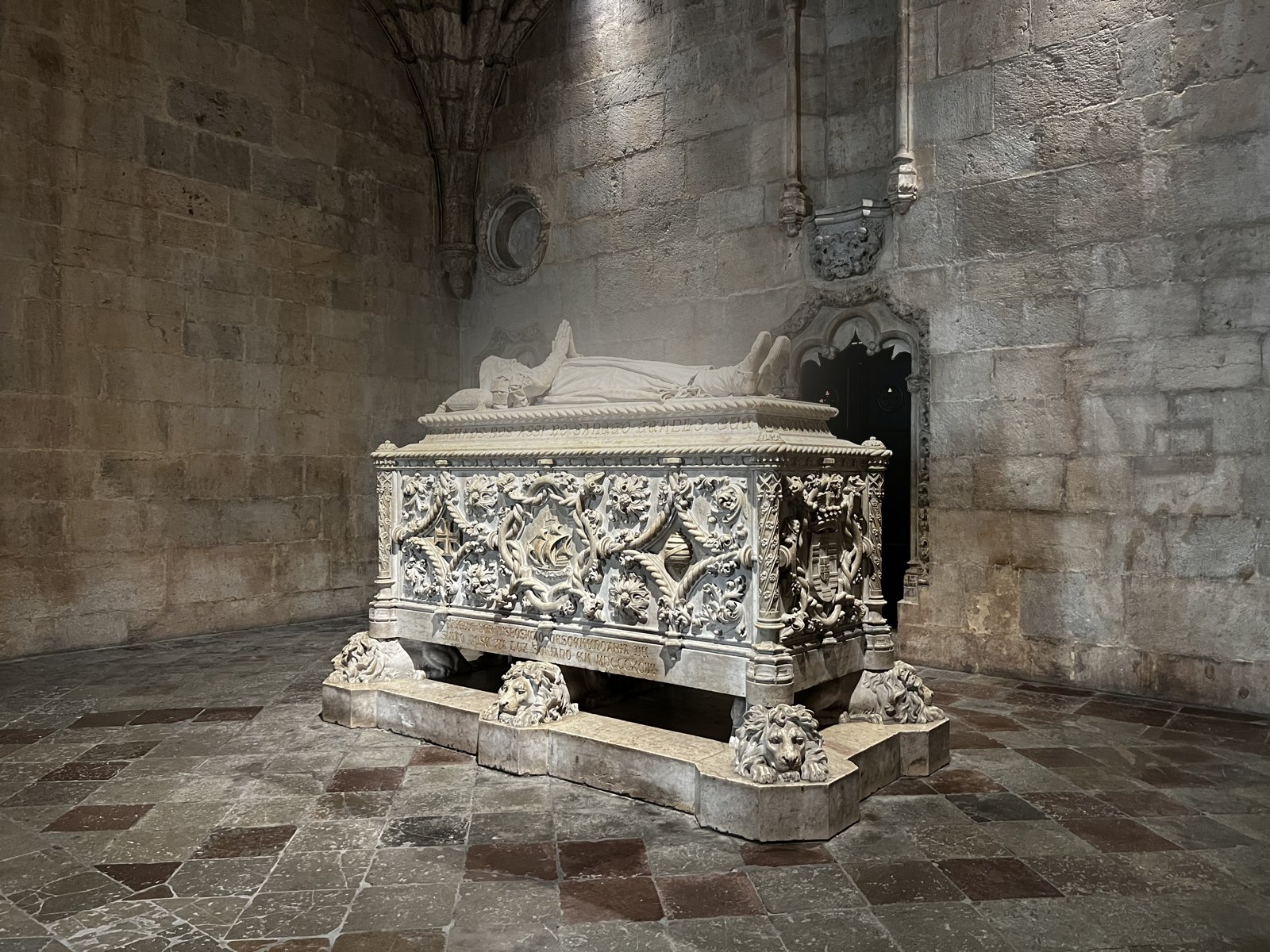
After the church we walked the two-story cloister (Claustro), upstairs and down. Every column and arch is covered in fine carving.
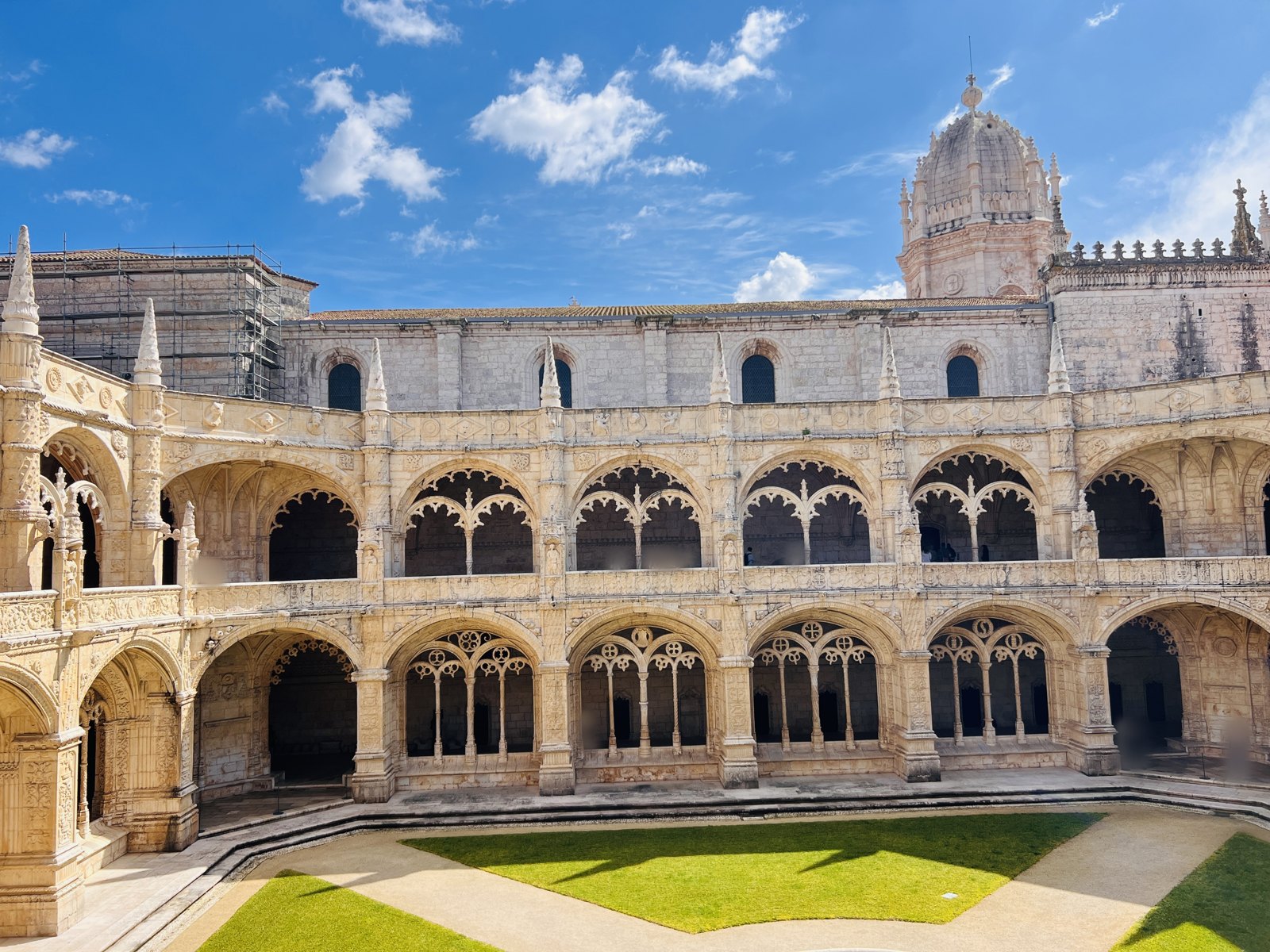


How long we spent
We got there around 12:45 p.m. and came out around 2:30. The church and the cloister took us close to two hours (going by our photo timestamps).
Jerónimos Monastery cloister tickets
This was where we spent the most time in Belém. You can also buy tickets ahead of time.
Pastéis de Belém and a late lunch
A short walk east of the monastery is Pastéis de Belém, the shop known as the original. They’ve been baking nata from the monastery’s old recipe since 1837.
We joined the line out front around 2:50 p.m. It didn’t take long, and we ate our nata right there outside the shop. Nata was good everywhere in Portugal; the original had a slightly crispier crust.
After the nata we had a late lunch at Adega de Belém nearby: a dish of potatoes, pork and clams, and grilled sardines.

National Coach Museum
After lunch we walked east to the National Coach Museum (Museu Nacional dos Coches). It reportedly opened in 1905 with the coaches collected by Queen Amélia. It was much bigger than I expected. I don’t think every coach I’ve ever seen, or will ever see, would add up to as many, or as many kinds, as I saw there. The huge, elaborate coaches, with all their carvings and symbols, went beyond anything I’d imagined a coach could be.


How long we spent
We went in just before 4 p.m. and looked around for about 30 minutes (by our photo timestamps). Then we called a Bolt to Belém Tower.
Belém Tower, the fortress at the river mouth
Belém Tower (Torre de Belém) stands where the Tagus meets the Atlantic. It’s a fortress tower built in the early 16th century to guard the river mouth, and it too was reportedly built under Manuel I to honor Vasco da Gama’s voyage. It served for defense and lookout, and was also used as a prison for political prisoners.
We got there around 4:40 p.m. and joined the line. The stairs inside are narrow, so they let people in in batches, and a line builds up easily. While we waited, our kid kept going back and forth to the water’s edge in case something showed up in the river.
We got inside a little after 5. From the terrace at the top we looked out over the Tagus and the far bank, and through a narrow window a white sailboat went by.


Later our kid drew a castle modeled on São Jorge Castle, and said the bridge in the drawing, the kind you’d see at an amusement park, came from Belém Tower.
How long we spent
About 25 minutes in line and about 30 minutes inside (by our photo timestamps). It closes at 5:30 p.m., so if you go late in the afternoon, leave plenty of time for the line.
Fish at the marina and a hand line
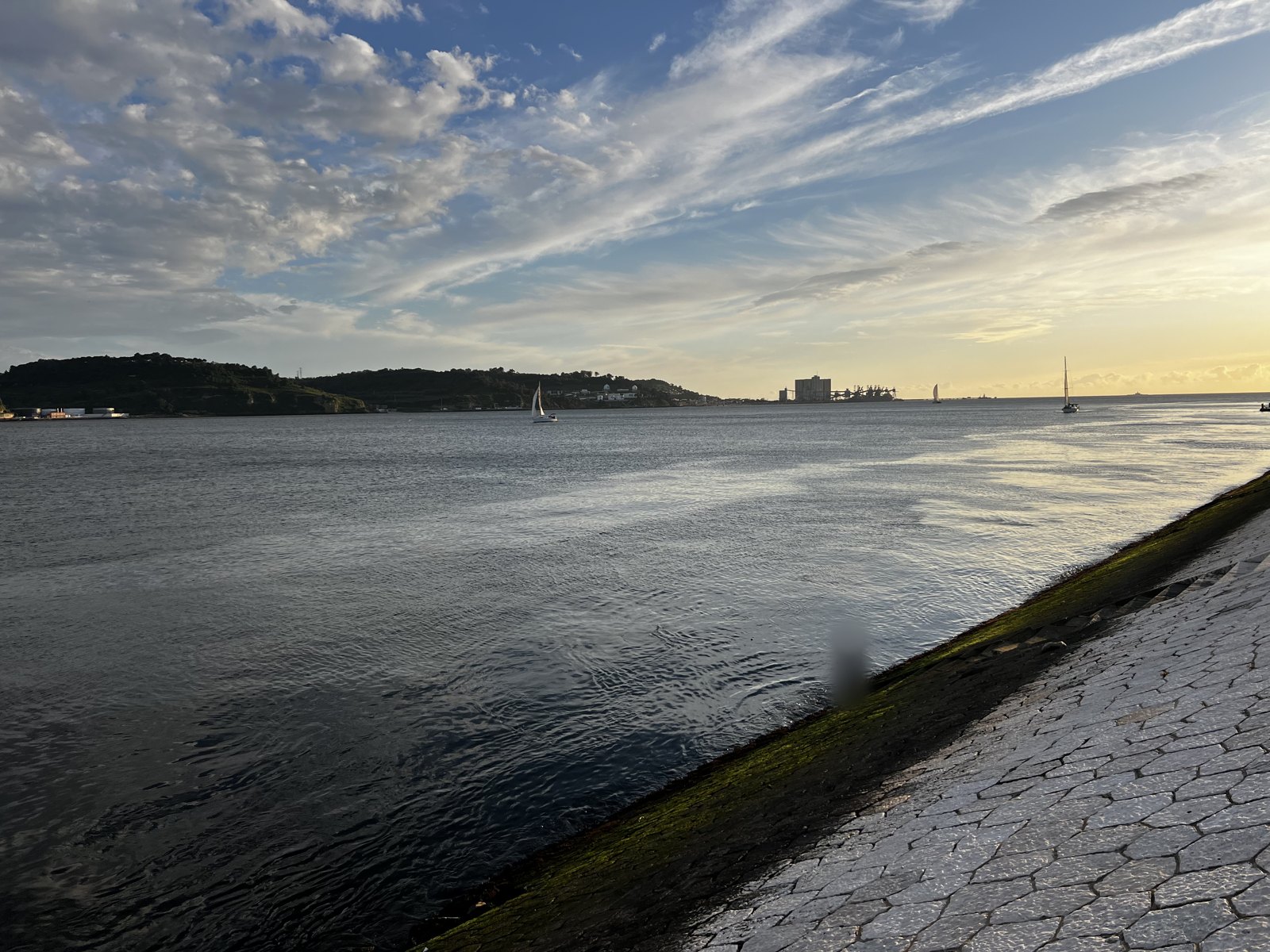
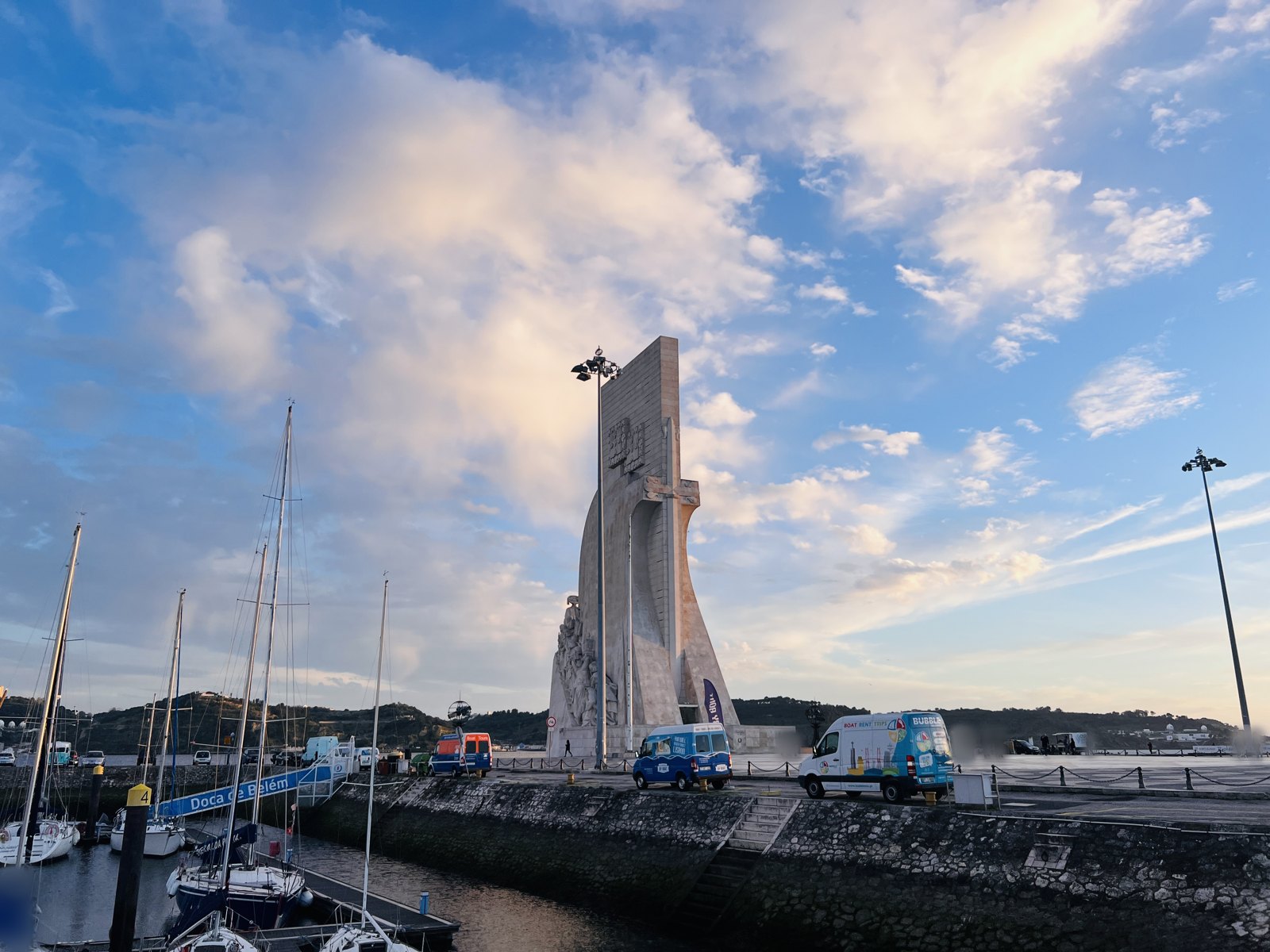
From Belém Tower we walked along the river to the Monument to the Discoveries. On the way we passed a marina full of yachts, and our kid was captivated by the fish in the water. Dozens of big fish were swimming between the boats. Just about the only thing our kid begged for on the whole trip was to go fishing right then.
So we took out the hand line we’d brought and tried casting from another spot on the water next to the marina. But the weight flew off somewhere it shouldn’t have, and that was the end of the fishing. Our kid couldn’t hide the disappointment.
A small fishing kit to bring along
Not the exact one we had. These are small fishing sets with a reel to wind the line on.
Monument to the Discoveries, the faces of an age
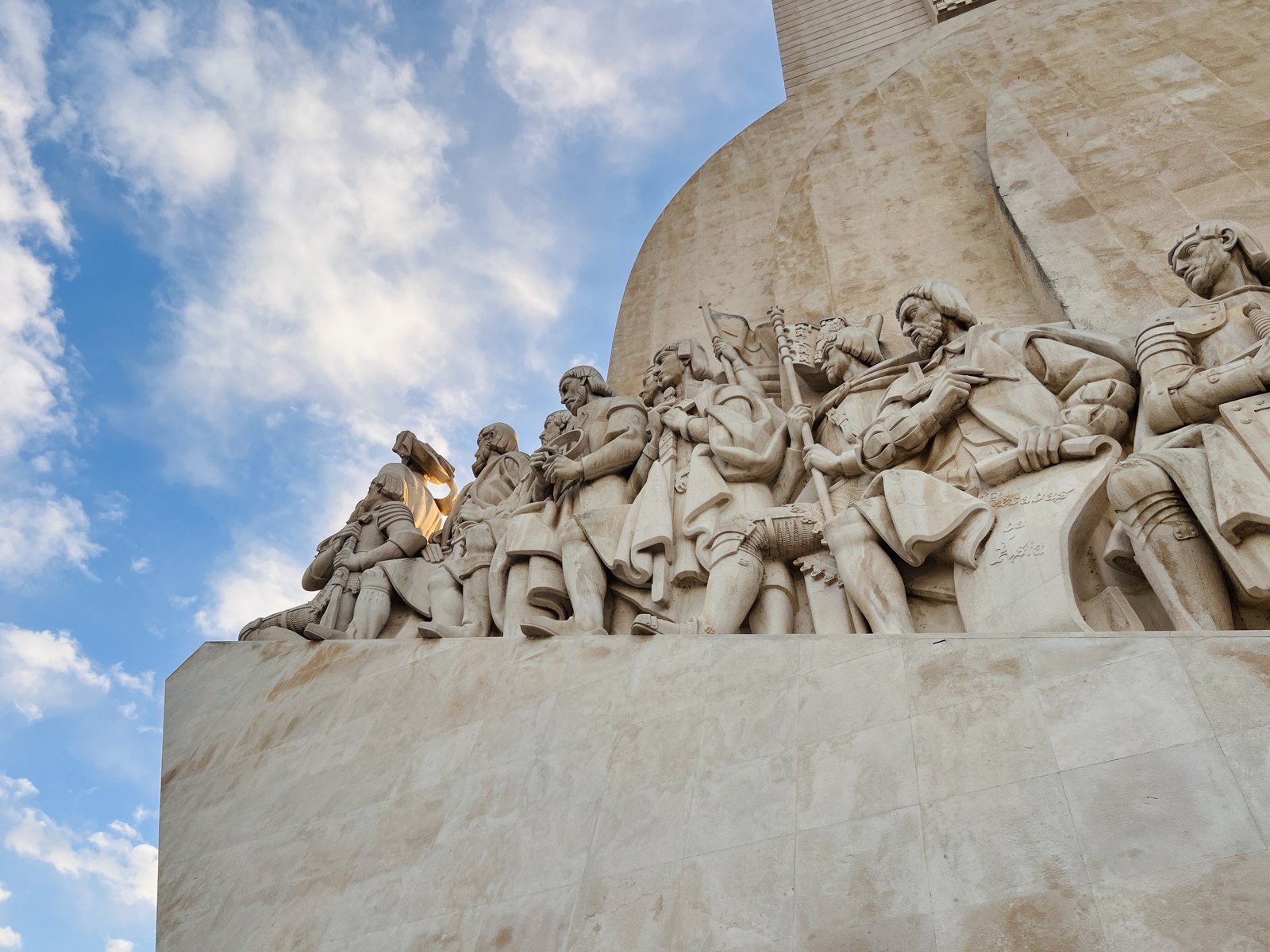
The Monument to the Discoveries (Padrão dos Descobrimentos) went up in 1960, which makes it a newcomer by Belém standards. Along both sides of the ship’s-prow monument are 33 figures of the Age of Discovery, led by Prince Henry the Navigator. Around 6:15 p.m. the low sun had turned the monument yellow.
I played a video game about the Age of Discovery as a kid, so a lot of the names felt familiar. It was an era that left its mark on the Western world and far beyond, and I found myself wondering how much past glory it must hold for the Portuguese.
How long we spent
From around 6:15 p.m. we spent a little over 20 minutes walking around the monument (by our photo timestamps). You don’t need a ticket to see it from outside.

A night in a small hotel in Baixa
A little after 6:30 p.m. we took a Bolt back downtown. We picked up the bags we’d stored that morning and moved to a small hotel in Baixa for the night, right next to the Santa Justa Lift we’d ridden on day one. We had decided to stay in Lisbon one more night and booked it that day, right in the center, so leaving the next morning would be easy.
A system problem meant a long wait to check in, and our key card failed twice, but the staff were kind and helpful every time. The room was small.
Dinner was octopus and seafood rice nearby in Baixa. Later that night we made a run to the Burger King near the hotel; our kid’s Burger King toy collection, started in Cascais the day before, was in full swing.

Places to stay in Baixa and Chiado
The area around the Santa Justa Lift and Rossio is easy to get around on foot. This is not the hotel we stayed at.
Day five: picking up the car and leaving Lisbon
On the morning of March 21 we packed up at the hotel and went to a downtown rental branch (Europcar, Lisbon Downtown). The pickup time on the contract was 10:48 a.m. The car was a Toyota, and we drove it around Portugal until we returned it in Porto on March 26.
Leaving the busy city for somewhere new was a little sad, and I was also curious about what was ahead. It meant leaving a neighborhood that had started to feel familiar in just a few days.
Our first stop after Lisbon was the Algarve coast in the south. The rest of the trip is in our 2-week Portugal itinerary, and the one-way rental and other prep are in our getting-around post.
Getting around Lisbon
Lisbon is built on seven hills, so you’re always going up or down. We walked most of the time. Chiado, Baixa and Largo do Carmo are all within walking distance of each other; for the steep hills and for farther places like Belém we took buses and taxis. The rental car, SIM cards and the Lisboa Card are covered in our post on getting around Portugal.
Lisboa Card
The Lisboa Card covers the Lisbon metro, Carris buses, trams and lifts, and CP trains to Sintra and Cascais, plus entry to dozens of museums and sights. It comes in 24-, 48- and 72-hour versions, and the clock starts when you first use it. There are separate prices for adults (16 and over) and children (4–15), and kids under 4 are free (Visit Lisboa and ticket sellers’ pages, checked October 2026). Depending on where you buy it, a card bought in advance comes as a voucher that you exchange for the physical card at an Ask Me Lisboa tourist office, including the one in the airport arrivals hall. We used ours on the Santa Justa Lift, bus 737 up to the castle and Tram 28.
The same sellers’ pages now list São Jorge Castle as included, along with Jerónimos Monastery, Belém Tower and the National Coach Museum (Lisboa Card sales site, checked October 2026). They also note that kids aged 13–15 need a separate castle ticket, so if your child is that age, check when you buy.
Lisboa Card
If you’ll be riding the metro, buses and trams several times a day and visiting sights like the castle, one card for everything is easier. It also covers the CP train to Sintra, and the castle’s official price list now shows free entry with the adult card (checked October 2026). We used the card on this trip.
Bolt
When the hills got to be too much or a place was a bit far, we called a Bolt. We also took one to and from Belém. Rides in Lisbon and Porto felt very cheap to us (as of March 2024).
Good to know
Hours and prices
São Jorge Castle
- Mar–Oct9 a.m.–9 p.m. last entry 8:30 p.m.
- Nov–Feb9 a.m.–6 p.m. last entry 5:30 p.m.
- Walls and towersIn summer they close earlier, between 6 and 9 p.m. depending on sunset; in winter, at 5:30 p.m.
- ClosedJan. 1, May 1, Dec. 24, 25 and 31
- PricesAdults €17, 65+ €14, ages 13–25 €8.50, 12 and under free, free with the (adult) Lisboa Card
- TicketsThe only official online seller is BOL (Bilheteira Online)
Santa Justa Lift
- ServiceOut of service since September 2025; reopening reported for January 2027, not confirmed by Carris
- CheckCarris notices for current status
Jerónimos Monastery
- CloisterTue–Sun 9:30 a.m.–5:30 p.m. last entry 5 p.m., ticket office closes 4:30 p.m.
- ChurchTue–Sat 10:30 a.m.–5 p.m.; Sundays and religious holidays 2–5 p.m.
- ClosedMondays, Jan. 1, Easter Sunday, May 1, June 13, Dec. 25
- PricesCloister €18, 12 and under free; 50% off for ages 13–24, 65+ and families with children under 18
National Coach Museum
- HoursTue–Sun 10 a.m.–6 p.m.
- ClosedMondays, Jan. 1, May 1, Easter Sunday, June 13, Dec. 25
- Prices€15, 12 and under free; 50% off for ages 13–24, 65+ and families with children under 18
- LocationThe new building at Avenida da Índia 136; the old royal riding school building is closed for works
Belém Tower
- HoursTue–Sun 9:30 a.m.–5:30 p.m.
- ClosedMondays, Jan. 1, Easter Sunday, May 1, June 13, Dec. 25
- Prices€15, 12 and under free; 50% off for ages 13–24, 65+ and families with children under 18
Monument to the Discoveries
- Mar–SepDaily 10 a.m.–7 p.m. last entry 6:30 p.m.
- Oct–FebDaily 10 a.m.–6 p.m. last entry 5:30 p.m.
- ClosedJan. 1, May 1, Dec. 24, 25 and 31
- Prices€10 (viewpoint, exhibition, film); ages 13–25 €5 (except Lisbon residents); under 12 free
Pastéis de Belém
- HoursDaily 8 a.m.–9 p.m., until 10 p.m. July–September
- Early closingDec. 24, 25 and 31 and Jan. 1, at 7 p.m.
- AddressRua de Belém 84–92
Checked on each official website and with Visit Lisboa in October 2026. Prices and hours can change.
Words to know
- Nata (pastel de nata) Portugal’s custard tart: flaky, many-layered pastry filled with custard and baked
- Arroz de marisco Portuguese seafood rice, simmered with seafood in plenty of broth
- Gun port An opening in a castle wall for firing cannon or guns through
3 days in Lisbon: questions, answered
How do you get from Lisbon Airport to the city?
We prebooked a pickup, and it took about 30 minutes to our place in Chiado. The metro works too, but with lots of luggage or a kid, a car to the door makes the first day easier.
Does the Lisboa Card get you into São Jorge Castle?
When we went in March 2024 it didn’t, so we paid separately. In October 2026 the castle’s official price list showed free entry with the adult Lisboa Card. Kids 12 and under are free anyway, and kids aged 13–15 are listed as needing a separate castle ticket.
What time should you get to São Jorge Castle for sunset?
On our mid-March visit, the sun set around 6:40 p.m. The walls and towers can close earlier, timed to sunset, so the relaxed plan is to arrive 30 minutes to an hour before sunset, climb the walls first, then watch the sunset.
Can you ride the Santa Justa Lift now?
It has been out of service since September 2025. A press report said it should reopen in January 2027, but Carris has not confirmed a date. In October 2026, Carris’s official website also listed the viewing deck at the top as temporarily closed. Check Carris’s notices before you go. Meanwhile, the Miradouro de São Pedro de Alcântara above Chiado looks out over Baixa and the castle together (Visit Lisboa, checked October 2026).
How do you get from downtown Lisbon to Belém?
Tram 15E from Praça da Figueira stops at “Mosteiro Jerónimos.” We took a Bolt both ways.
Is half a day enough for Belém?
We arrived around 12:45 p.m. and left around 6:30 p.m. The monastery, nata, lunch, the Coach Museum, Belém Tower and the Monument to the Discoveries took us about six hours. Lines at the monastery and Belém Tower can stretch that.
Can you visit Belém on a Monday?
Jerónimos Monastery, the Coach Museum and Belém Tower are closed on Mondays. On a Monday you’re limited to the Monument to the Discoveries, Pastéis de Belém and a walk along the river.
Is the line at Pastéis de Belém long?
Around 3 p.m. on a weekday in March, we didn’t wait long in the takeout line (by our photo timestamps). It opens at 8 a.m. every day.
How many days do you need in Lisbon?
We stayed four nights: two days in the city, one in Belém and one out toward Sintra. Even with a kid, no day felt rushed, and there’s so much to see in and around Lisbon that we could happily have stayed longer.
Wrap-up
- Time spentFour nights in Lisbon: two days in the city, one day in Sintra (separate post), about six hours in Belém (12:45 p.m. at the monastery to 6:30 p.m. leaving the Monument to the Discoveries)
- Getting aroundOn foot downtown, buses on the Lisboa Card for the steep hills, Bolt to and from Belém
- Best forFamilies visiting Lisbon for the first time; anyone who wants one day walking the city, one evening watching the sunset from the castle and one day following the Age of Discovery
- Next timeIn a city we don’t know yet, book only what really needs booking and walk wherever our feet take us. That approach worked well for us in Lisbon
Our four days in Lisbon started with a bite of nata. The castle we saw on the hill from the top of the lift on our first night became the place we watched the sunset the next evening, and the night on Praça do Comércio stays with me as our kid running after a glowing propeller. On day four we spent the whole day in Belém, following the traces Portugal left when it opened the Age of Discovery. You run into those traces in many places around the world, and spending a day at the river mouth where it all set out stayed with me long after the trip. On the morning of day five we picked up the rental car and drove south, and that was the end of Lisbon. In a new city, I like to book only what has to be booked and wander for the rest. Lisbon was exactly that, and that’s why I loved it.
Related posts
What we checked 12 sources
- São Jorge Castle official website (hours, wall access, closing days; checked October 2026)
- São Jorge Castle official website (prices, official ticket seller; checked October 2026)
- Visit Lisboa, Lisboa Card sales page (transit and sights included, age bands, temporarily closed attractions; checked October 2026)
- Lisboa Card sales site (sights included; checked October 2026)
- Museus e Monumentos de Portugal, Jerónimos Monastery (hours and prices; checked October 2026)
- Museus e Monumentos de Portugal, Belém Tower (hours and prices; checked October 2026)
- Museus e Monumentos de Portugal, National Coach Museum (hours, prices, address; checked October 2026)
- Museus e Monumentos de Portugal, tickets (free entry and discounts; checked October 2026)
- Monument to the Discoveries official website (hours) and prices (checked October 2026)
- Pastéis de Belém official website (hours and address; checked October 2026)
- Carris, Tram 15E route (checked October 2026)
- OGIMET daily weather summaries: Lisbon station (08535), March 2024
Our 2 weeks in PortugalSee the full itinerary →
- March 17·203 days in Lisbon and Belémyou are here
- March 19Sintra, Cabo da Roca and Cascais
- March 21–22Two days on the Algarve
- March 23Alte and Évoracoming soon
- March 24Óbidos and Nazarécoming soon
- March 25Coimbra and Aveirocoming soon
- March 26·28Porto (1): river and bridgescoming soon
- March 27·29Porto (2): the coast and eveningscoming soon
- March 30–31One night in Brusselscoming soon
- TopicGetting around & prep
- TopicFood
The day-by-day posts are coming in order; topic posts (getting around, food) are listed at the end.
Not in the list? Search it yourself
Affiliate link: if you book through this search, the blog earns a commission at no extra cost to you. Results open in a new tab. Details
Discover more from Elsewhere, Mostly
Subscribe and get new posts sent straight to your inbox.